How to Measure Window Blinds: UK Expert Guide 2026
You're probably standing at the window with a tape measure in hand, looking at a recess that seems square enough, and wondering why ordering blinds feels like a job that can go wrong so easily.
That instinct is correct. Measuring blinds isn't difficult, but it is unforgiving. In UK homes, especially those with older timber frames, newer UPVC windows, bay fronts, trims, sills, handles, and vents, a small measuring mistake can turn a made-to-measure order into a poor fit. The same is true when you move from blinds to bespoke insect screening. A screen that's even slightly wrong won't seal properly.
If you want to measure window blinds properly, work like a fitter. Decide the mount first. Measure the actual opening, not the old blind. Check depth, squareness, and obstructions before you write down a single final figure.
Your Toolkit and First Decision Inside vs Outside Mount
The first mistake happens before the tape comes out. People start measuring before they've decided inside mount or outside mount.
That choice changes everything. An inside mount sits within the recess and gives a neater, built-in look. An outside mount fixes to the face of the frame, wall, or trim and covers the opening from the outside. If you switch your mind halfway through, the numbers you took may be useless.
What you actually need
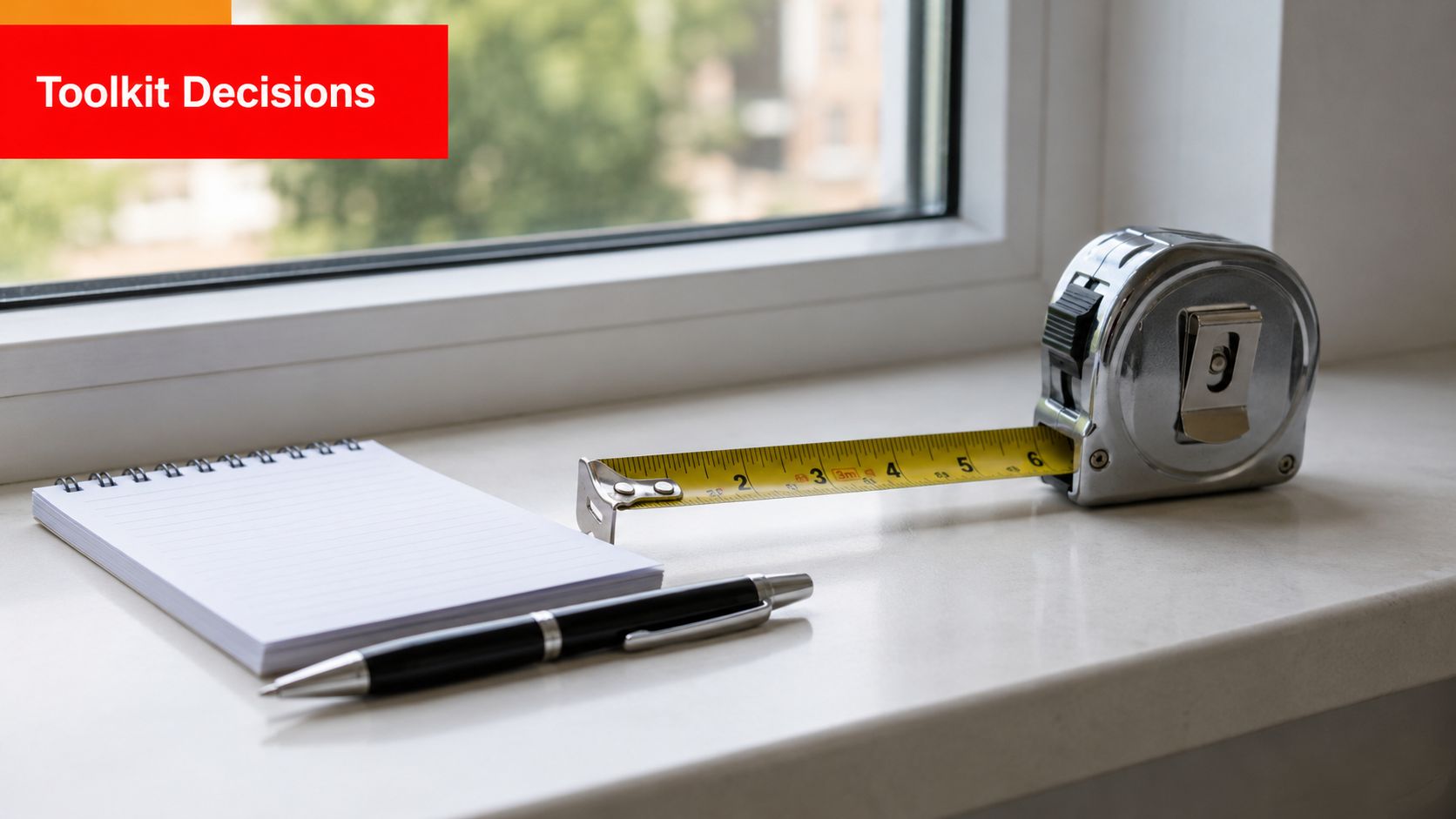
Keep the kit simple:
- Metal tape measure. Use a rigid metal tape, not a cloth sewing tape. Cloth flexes, bows, and gives false readings in a recess.
- Notepad and pen. Sketch the window and write dimensions directly onto the sketch.
- Step stool if needed. You need to see the top of the recess properly, not guess from below.
- Your phone camera. A quick photo of the frame, handles, vents, or trims helps when you review measurements later.
A rough sketch matters more than often realized. Draw the opening, note top, middle, bottom, then left, centre, right. Mark where handles sit, whether a sill projects, and whether a trickle vent interrupts the top line.
Practical rule: If you can't explain on paper where each number came from, you're not ready to order.
How to choose the mount
Choose inside mount when the recess is deep enough, reasonably square, and free from obstructions that would foul the blind. This is the cleaner look and usually the first choice where the frame allows it.
Choose outside mount when the recess is shallow, uneven, interrupted by hardware, or when you want broader coverage over the opening. That often solves problems that inside-mount instructions ignore.
For homeowners also thinking about insect control, the same judgement applies to window fly screens. The usable fixing surface matters as much as the opening size.
If you want another practical walkthrough before you start, this expert guide for homeowners on measuring blinds is a useful companion because it reinforces the same idea fitters rely on: decide the fitting method first, then measure for that method only.
Quick decision check
| Situation | Better option |
|---|---|
| Deep, clear recess | Inside mount |
| Shallow frame or limited fixing depth | Outside mount |
| Handles, vents, sensors in the recess | Often outside mount |
| You want a built-in look | Inside mount |
| You want broader coverage across the opening | Outside mount |
Mastering the Inside Mount Measurement
A recess can look straight until the tape proves otherwise. In UK homes, especially older terraces and semis, one side of the opening is often tighter, the head can dip, and a UPVC frame that looks generous can lose usable space once you account for beads, vents, and handles.
Inside mount works well when the recess is honest. Measuring it properly means finding the tightest point, the true drop, and the actual fixing depth. If any one of those is wrong, the blind may arrive too wide, sit off-level, or foul the hardware every time it moves.
Take the width properly
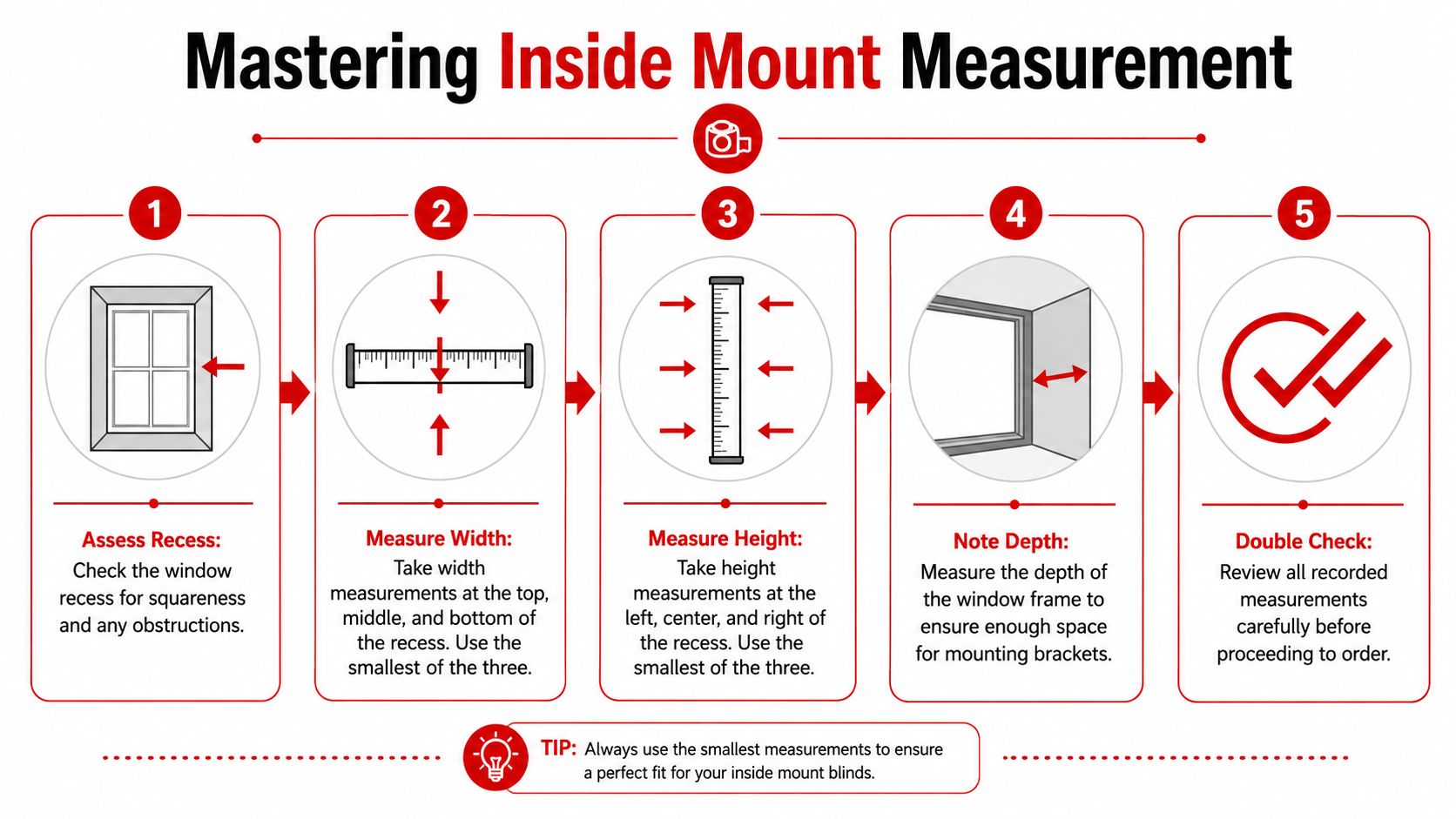
Measure the clear recess width in three places:
- Top, just under the head of the recess
- Middle, halfway down
- Bottom, just above the sill return or lower frame line
Keep the tape flat and level. Measure from hard surface to hard surface. Do not pick up a plaster bellied out at one point, a timber staff bead, or a trim piece that sits proud but is not part of the true opening.
Write each figure down exactly as read. Use the smallest width for an inside mount. That is the point that decides whether the blind fits.
I see one mistake repeatedly. Homeowners measure the glass or copy the old blind size. Neither tells you what the recess will accept.
Take the drop with the same care
Now measure the height on the left, centre, and right.
Run the tape from the top fixing point to the point where the blind should finish inside the recess. In a neat plastered opening that may be the sill. In a tiled kitchen reveal or older timber window, it may be the lowest consistent line that gives the blind a clean finish without catching.
Use the longest drop only if the supplier specifically asks for it. For many made-to-measure blinds, the three drop measurements show whether the opening is out of square, which matters just as much as the final number. Make a note on the sketch if the sill rises, the head slopes, or one side return is visibly twisted.
Depth decides whether inside mount is realistic
Width and drop are only half the job. The blind still needs room to sit and operate.
Check the recess depth where the brackets will fix. Then check the same area for anything that projects into the blind's path. In UK windows that usually means trickle vents, tilt-and-turn hardware, cockspur or espag handles, chunky glazing beads, and timber frames that are not parallel from front to back.
UPVC catches people out here. The frame may measure deep enough at the side, but the handle sits exactly where the blind stack, bottom rail, or slats need to pass. Timber can be worse because old paint build-up and slightly bowed liners reduce the usable depth in ways a quick glance misses.
Measure the space the blind will use.
The same habit carries over to retractable fly screens for windows. Both products depend on clean fixing lines and enough clearance through the full travel, not just an opening that looks wide on first inspection.
A reliable fitter's routine
Use the same order every time so nothing gets missed:
- Sketch the window first. Mark top, middle, bottom, then left, centre, right.
- Record all three widths exactly as measured.
- Record all three drops exactly as measured.
- Measure usable depth where brackets will sit, not at the easiest point to reach.
- Check for obstructions at the top, sides, and operating path.
- Read the numbers back before you order.
Averaging the width is where many DIY jobs go wrong. So is rounding up because the recess "looks close enough." Inside mount is less forgiving than people expect. If the bottom is 4 mm tighter than the top, that smaller figure is the one that matters.
When and How to Choose an Outside Mount
Outside mount isn't a compromise. In plenty of homes, it's the cleaner technical answer.
If the recess is shallow, twisted, interrupted by a trickle vent, or crowded by handles, an inside mount can turn into a constant nuisance. The blind may rub, sit forward awkwardly, or leave the opening looking pinched. An outside mount avoids those battles because it uses the face around the window rather than the tightest point inside it.
When outside mount is the better answer
Use it when the opening gives you one of these problems:
- Insufficient recess depth for brackets or headrail
- An uneven reveal that would make an inside blind sit crooked
- Top vents or projecting hardware that interrupt the recess line
- A need for broader coverage to improve privacy and reduce side light
For outside mounts, supplier guidance commonly recommends adding 20 cm (7.874 in) to the overall width so you get 10 cm (3.937 in) overlap on each side, which is intended to improve light blocking and privacy according to this outside mount measuring guidance.
How to measure it cleanly
Outside mount is simpler in one sense because you're not fighting the internal narrow point. But you do need to be deliberate about where the blind begins and ends.
Measure the area you want covered, not just the visible glass. Then decide the head position and the final drop. If trim is uneven, take measurements from fixed reference points, such as the outer frame edge or wall line, not from decorative mouldings that vary.
A practical way to judge it is this:
| Question | If yes |
|---|---|
| Is the recess too tight for reliable movement? | Choose outside mount |
| Do you want the blind to cover beyond the frame edges? | Choose outside mount |
| Is the top of the recess broken by a vent or trim detail? | Choose outside mount |
This logic also matters if you're looking at retractable fly screens for windows, because the fixing plane around the opening can be more reliable than the recess itself when the frame is interrupted or shallow.
Measuring Special Windows and Obstructions
Generic guides assume every opening is a neat rectangle. A lot of UK homes aren't built like that.
The awkward jobs are usually the memorable ones. A bay in an older front room. A kitchen window with a trickle vent and a handle that projects further than it should. A side opening where one reveal is plumb and the other plainly isn't. These aren't rare edge cases. They're everyday measuring work.
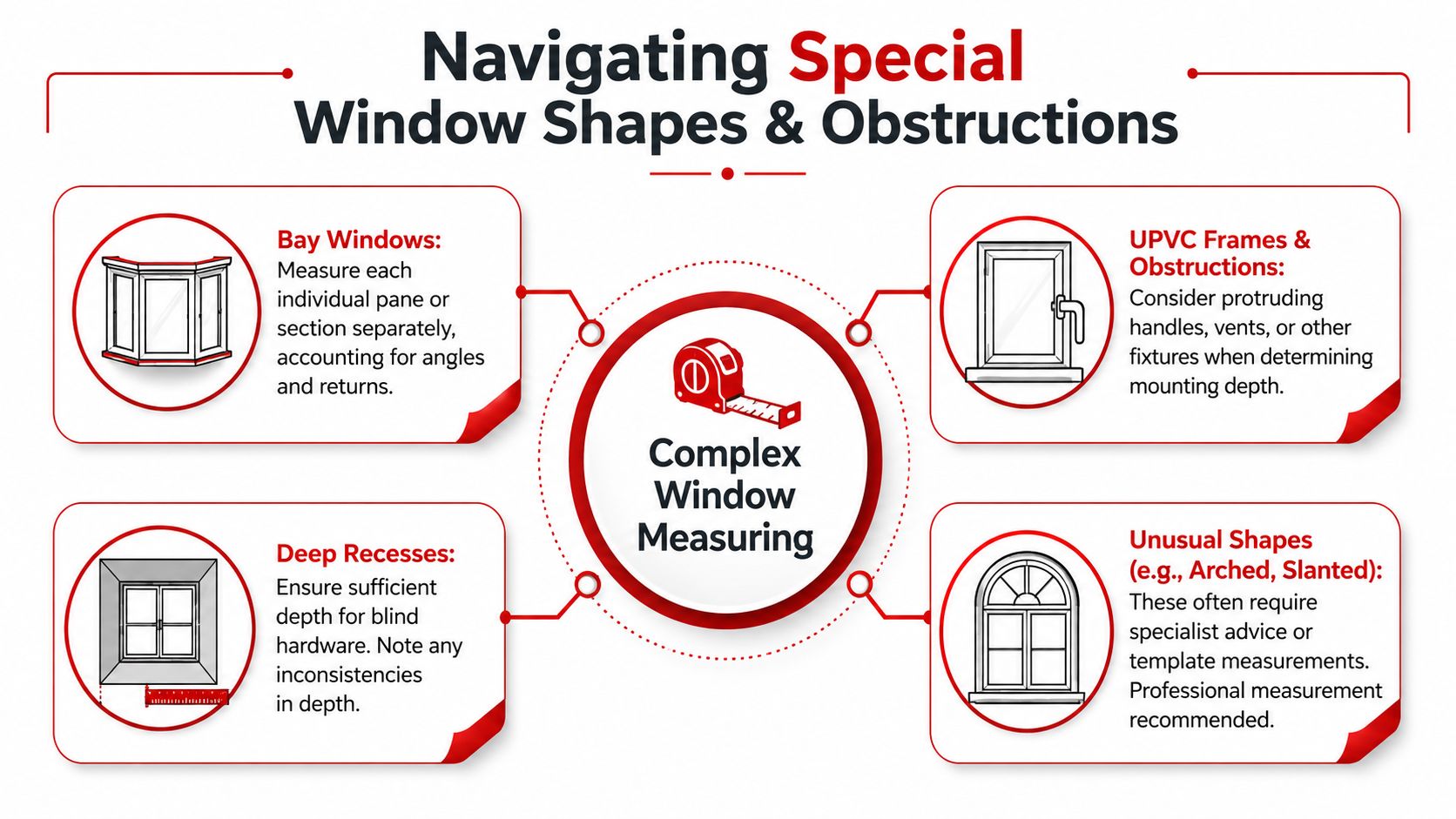
Bay windows need mapping, not guessing
Bay windows are common in Victorian and Edwardian properties, and the usual advice to take one short width isn't enough. The workable method is to map each bay segment and its angles individually, as described in this guidance on measuring angled and complex windows.
Treat each face of the bay as its own measuring job. Record:
- The width of each section
- The drop for each section
- Where returns or junctions meet
- Any angle or projection that affects how blinds sit
If you try to force one simple number across a bay, the alignment goes off quickly. Headrails clash, returns show gaps, and the whole installation looks like separate jobs that don't belong together.
UPVC windows with handles and vents
Modern windows create a different kind of problem. The frame may look more regular, but the hardware often steals the usable space.
A trickle vent at the top can break the fixing line. A handle can project into the blind's travel. An alarm sensor may sit exactly where a side channel or bracket wants to go. Measure all of these as physical obstacles, not minor details.
On a complex window, the opening size is only half the job. The rest is proving the product can move without hitting anything.
A useful routine is to open and close the sash fully before measuring. Check where the handle rests, whether it protrudes beyond the frame face, and whether a vent cover sits proud of the head. If anything interrupts the plane of the blind or screen, note it on the sketch.
Angled and irregular shapes
Angled tops, sloping bottoms, and other non-rectangular openings have to be approached as geometry. Measure the tall side, short side, and the angled run. Don't compress that into a single width-by-drop note and hope the manufacturer sorts it out.
For shapes like these, make a simple field record:
| Feature | What to capture |
|---|---|
| Angled side | Tall point and short point |
| Sloping head or sill | Start and end heights |
| Irregular reveal | Any point where the frame steps or narrows |
| Mounting face | Flat fixing area available |
That same habit carries directly into bespoke screening work. Blinds need clean movement. Screens need clean sealing. If the frame has returns, beads, handles, or vent covers, those details decide whether the final fit works.
Common Mistakes and Your Printable Measurement Checklist
The most expensive measuring mistake is usually the one that felt harmless at the time.
People take one width reading because the frame looks square. They copy numbers from an old blind. They use a flexible tape because it's nearby. Then they wonder why the finished blind catches at one point or leaves light on the other side.
A particularly common error is averaging widths in an uneven opening. That fails because the blind still has to pass the tightest point. The more reliable method is to order to the narrowest width taken across the opening, as explained in this guidance on avoiding blind snags and light gaps.
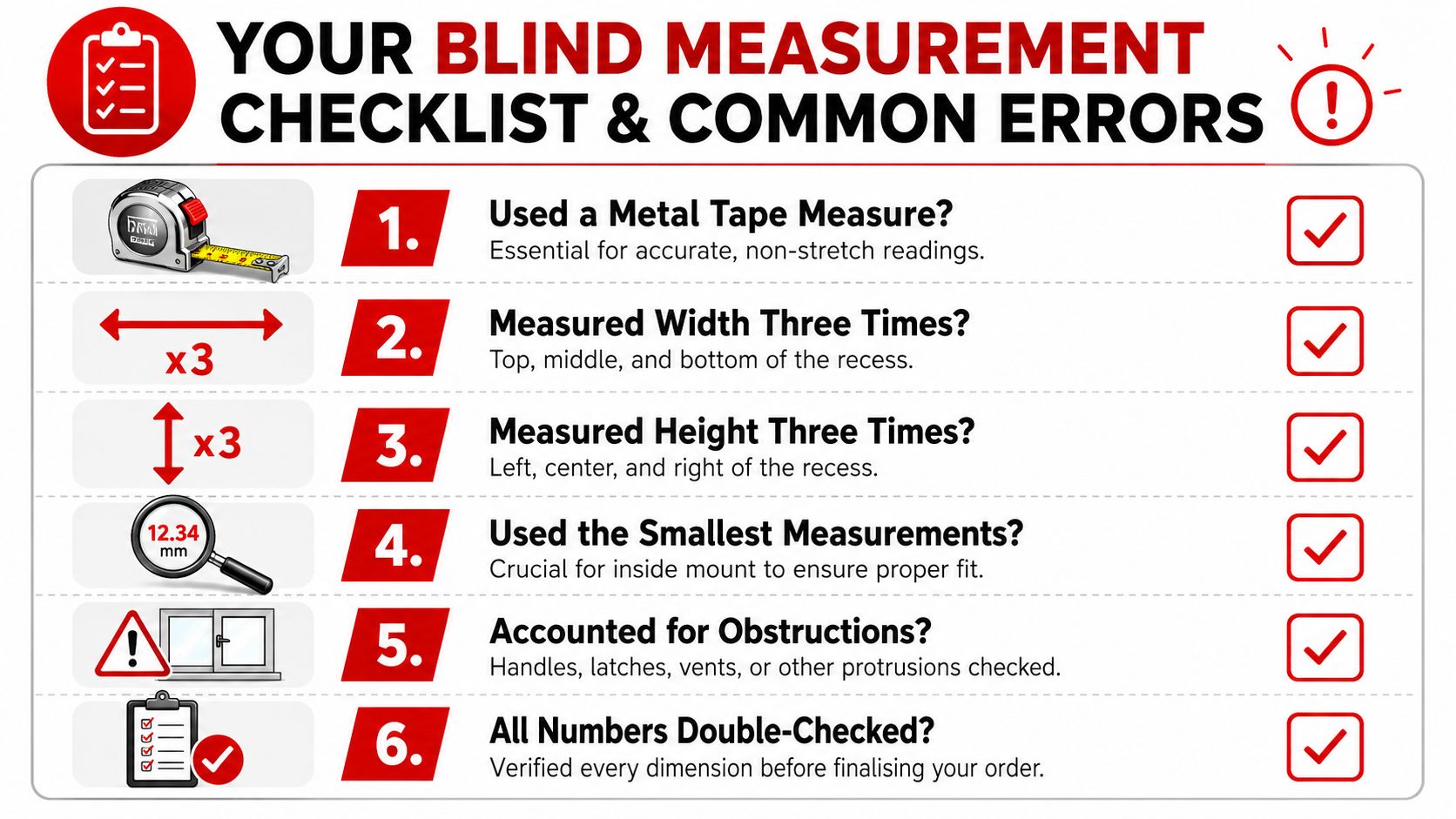
The mistakes that keep recurring
- Using the wrong tape. A cloth tape can't hold a straight line across a recess.
- Measuring once. Openings vary more than people expect.
- Swapping width and height. This happens more often than most homeowners realise.
- Ignoring depth. A blind needs room for brackets and movement, not just nominal width and drop.
- Forgetting obstructions. Handles, vents, catches, and sensors all count.
- Writing rounded figures from memory. Record the reading immediately.
Printable checklist
Print this and take it room to room.
- Window ID. Label the room and exact window.
- Mount type chosen. Inside or outside, decided before measuring.
- Width points recorded. Top, middle, bottom.
- Height points recorded. Left, centre, right.
- Depth checked. Include any reduced depth caused by hardware.
- Obstructions marked on sketch. Handles, vents, trims, sensors.
- Final order size confirmed. Based on the correct rule for the chosen mount.
- Numbers read back once more. Preferably after a short break, not immediately.
Final check: Never trust the number you meant to write. Trust the number you wrote down and then verified.
If you want good results when you measure window blinds, the discipline matters more than speed. Careful measuring looks slow, but reordering is slower.
Applying Your Skills to Bespoke Fly Screens
You measure a blind recess carefully, order with confidence, then switch to a fly screen and assume the same numbers will do the job. That is where gaps appear. A blind can still look acceptable if an opening is slightly out of square. A fly screen has to meet the frame cleanly all the way round, or insects find the weak point straight away.
That is why blind measuring is a strong foundation, not the finished skill.
In UK homes, the frame detail decides the result as much as the width and drop. UPVC often gives you a neat flat face until a trickle vent, handle backplate, or chunky gasket interrupts it. Older timber windows bring different problems. Paint build-up, uneven staff beads, and openings that are visibly out of square can all reduce the usable fixing area even when the tape reading looks fine.
The method carries over well if you shift your focus from fabric coverage to contact and clearance. For a screen, check:
- the exact fixing face the screen frame will sit on
- whether that face stays flat and continuous around the full perimeter
- whether handles, vents, catches, beads, or trims break the seal or foul the screen
- whether the window can still open and close freely with the screen fitted
A kitchen window is a common example. The side measurements may be straightforward, but a top vent cover can project far enough to spoil the head fixing line. I see this often on UPVC frames. Homeowners measure the opening, not the surface the screen has to land on, and the finished frame ends up rocking at the top corners or sitting proud on one side.
Timber casements need even more care. The tape may say the frame face is wide enough, but the fixing line can still be poor because old paint has rounded the edges, mouldings step in and out, or one side has twisted slightly over time. On houses with age in them, especially in the UK, measuring three points is only the start. Sight along the frame and use your fingers as well as the tape. You are checking for a reliable mounting surface, not just collecting numbers.
If you are looking at magnetic fly screens for windows, this matters even more because the frame needs a consistent contact line to sit properly and perform as intended.
The key question is whether the fixing surfaces stay clear across the full operating path.
That means asking the right questions at the window itself:
- Where will the screen mount?
- Is that mounting face flat, solid, and continuous?
- What interrupts the seal or the opening action?
Answer those properly and you are no longer guessing from width and height alone. You are specifying a made-to-measure product the way a fitter would.
For a useful outside perspective on access, ventilation, and frame-mounted screening, read Cultivate House Detailing's screen insights.
If you've measured up and want a made-to-measure screen based on those same fitting principles, Premier Screens Ltd provides bespoke fly screens for windows and doors across the UK. Use your recorded opening sizes, depth notes, and obstruction checks to choose the right screen style with fewer fitting surprises.