

Fly Screens Retractable: A UK Buyer’s Guide for 2026
You open the back door for ten minutes of fresh air, and within moments you've invited in a fly, a wasp, and the kind of evening irritation that sends everyone reaching for a tea towel. That's the point at which consideration for fly screens retractable systems often arises.
They solve a very British problem. We want airflow when the weather turns warm, but we don't want a permanent screen spoiling the look of the opening all year. That matters just as much in a Victorian terrace with painted timber as it does in a newer house with white uPVC and wide patio doors.
What's made retractable screening more relevant is the simple fact that warmer, still periods are helping insects stay active for longer. The Met Office-related guidance discussed here notes that UK weather patterns increasingly create warm, still periods that support longer mosquito activity seasons, and it also reinforces why physical barriers remain such a practical answer. A retractable screen lets you keep a window or door open for ventilation, then disappears back into its cassette when you don't need it.
That disappearing act is the difference between a screen people tolerate and a screen people use. Fixed options have their place, but if the opening is part of your garden view, your kitchen light, or the character of the front elevation, retractable designs usually make more sense.
The Modern Solution to Fresh Air Without Insects
A lot of buyers arrive at the same conclusion after trying cheaper workarounds. They've used sticky strips, temporary mesh, magnetic curtains, or kept windows shut during the worst part of the season. None of those options really deals with the main need, which is controlled ventilation without turning the opening into a permanent visual compromise.
That's where retractable systems earn their place. When the screen is open, you get the barrier. When it's closed away, you get the original appearance of the window or door back. On period properties, that helps preserve mouldings, sightlines, and painted joinery. On modern homes, it avoids adding a bulky layer that fights against slim frames and large glazed openings.
Why retractable works in everyday use
The practical advantage isn't just appearance. It's that people are more likely to use a system that feels easy and unobtrusive. A screen that glides across a doorway for summer evenings, then tucks away when the weather changes, tends to stay in service. A clumsy screen often ends up ignored.
In homes, that usually means kitchen doors, French doors, patio sliders, and bedroom windows where airflow matters most. In small businesses, it often means rear access doors, staff entrances, and preparation spaces where people need ventilation but can't leave openings exposed.
Practical rule: The best screen is the one you'll actually keep open and closed without thinking about it. If it looks awkward or feels awkward, it won't get used properly.
Why generic advice falls short in the UK
Most guides talk about style first. In real installations, style is only half the job. UK housing stock is mixed, and the opening you're fitting into may be straight, twisted, shallow, repaired, painted over, or altered more than once over the years.
That's why a good buying decision starts with fit, operation, and mesh choice before colour and finish. If those three are right, the screen usually feels like it belongs there. If they're wrong, even an attractive product becomes annoying very quickly.
Understanding Retractable Screen Systems
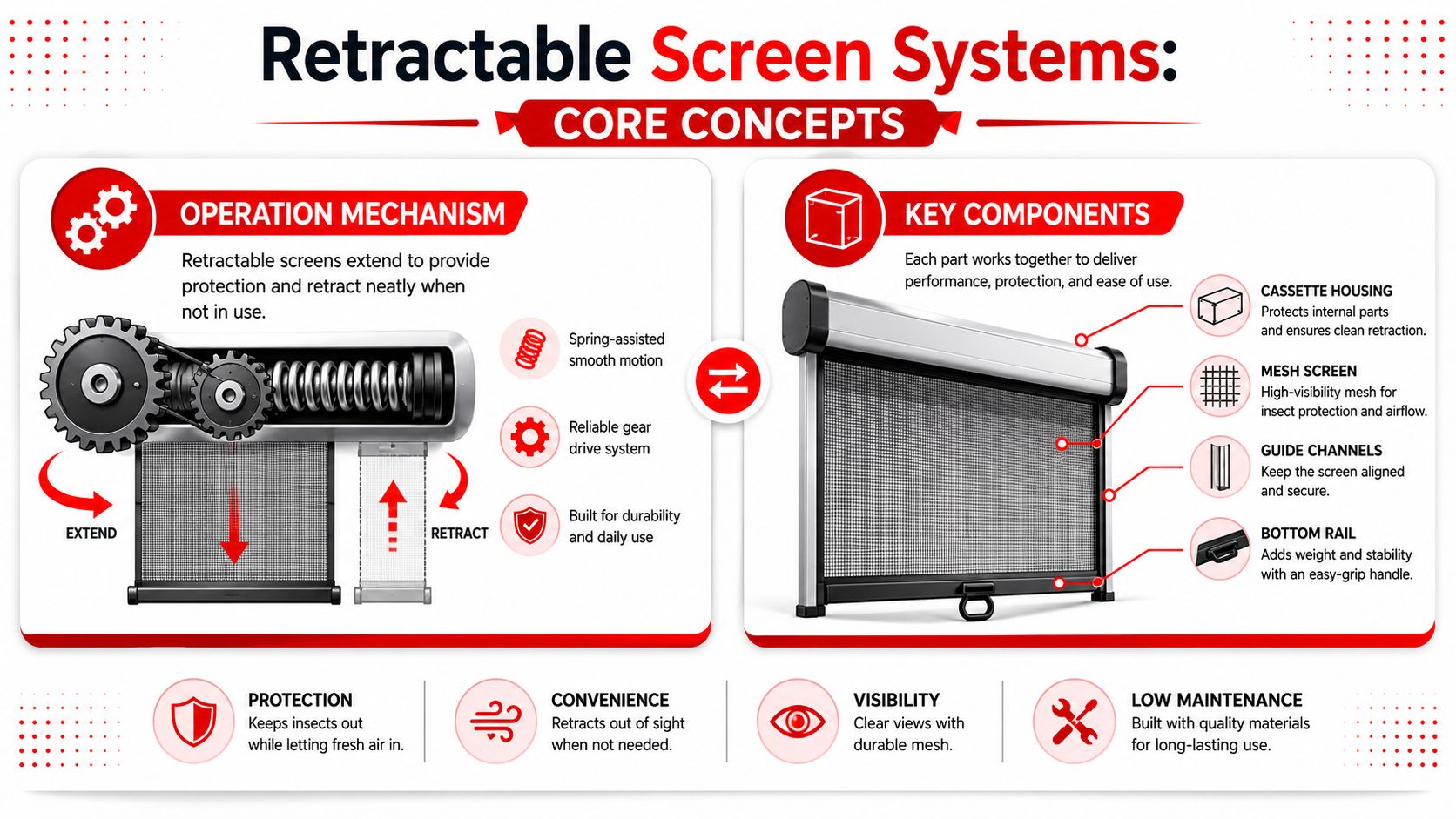
Retractable screens are simple in principle, but the details matter. A mesh panel sits under tension and travels within a controlled frame. The housing keeps the mesh protected when it's not being used, and the guide system keeps the movement straight enough to maintain a usable seal.
What the main parts actually do
A retractable screen system usually comes down to four working parts:
- Cassette housing keeps the mesh rolled and protected when the screen is parked.
- Guide rails or side channels control the screen's path so it doesn't wander or rub.
- Tension system pulls the mesh back smoothly and helps it sit properly in use.
- Handle or pull bar gives the user a solid point to operate the screen without twisting the mesh.
When these parts are well matched, the screen feels light but controlled. When they aren't, you get snapping, drag, poor tracking, and edge gaps.
Vertical and horizontal systems
For windows, the screen usually moves vertically. That suits openings where you want the screen to drop or rise within a compact reveal. It also works well on many kitchen and bathroom windows where there isn't much room for a side-running arrangement.
For doors, the screen usually runs horizontally. That's the familiar format associated with Retractable insect screen doors, where the mesh travels across the opening and returns into a side cassette. It's practical for single doors, French doors, and many patio access points because the screen can disappear fully when traffic is heavy.
Single and double screen layouts
A single screen runs from one side of the opening to the other. That's usually right for a standard doorway or a narrower patio opening.
A double screen has two units that meet in the middle. This is often the cleaner answer on wider openings because each screen only has to cover part of the span, which helps with control and balance.
The engineering starts to matter a lot on bigger openings. For large spans, manufacturer data for comparable systems shows double-screen configurations can span up to 9.5 m, and keeping those screens working properly depends on strong cassette springs and stiff side channels. If those elements aren't up to the job, the mesh can sag, drift, or fail to meet tightly enough at the edges.
A wide opening doesn't just need a bigger screen. It needs better tension control, straighter channels, and tighter installation tolerances.
What works and what doesn't
What works:
- Straight runs on properly measured openings
- Good frame support at fixing points
- A screen type matched to how often the opening is used
- Enough tension to retract cleanly without slamming
What doesn't:
- Treating every doorway like a standard door
- Using a wide single screen where a double would control better
- Ignoring threshold detail
- Assuming the wall or frame is straight because it looks straight
That last point catches a lot of people out. Retractable systems are forgiving up to a point, but they aren't magic. They need a frame that gives the hardware a fair chance to run properly.
How to Choose the Right Mesh for Your Screen
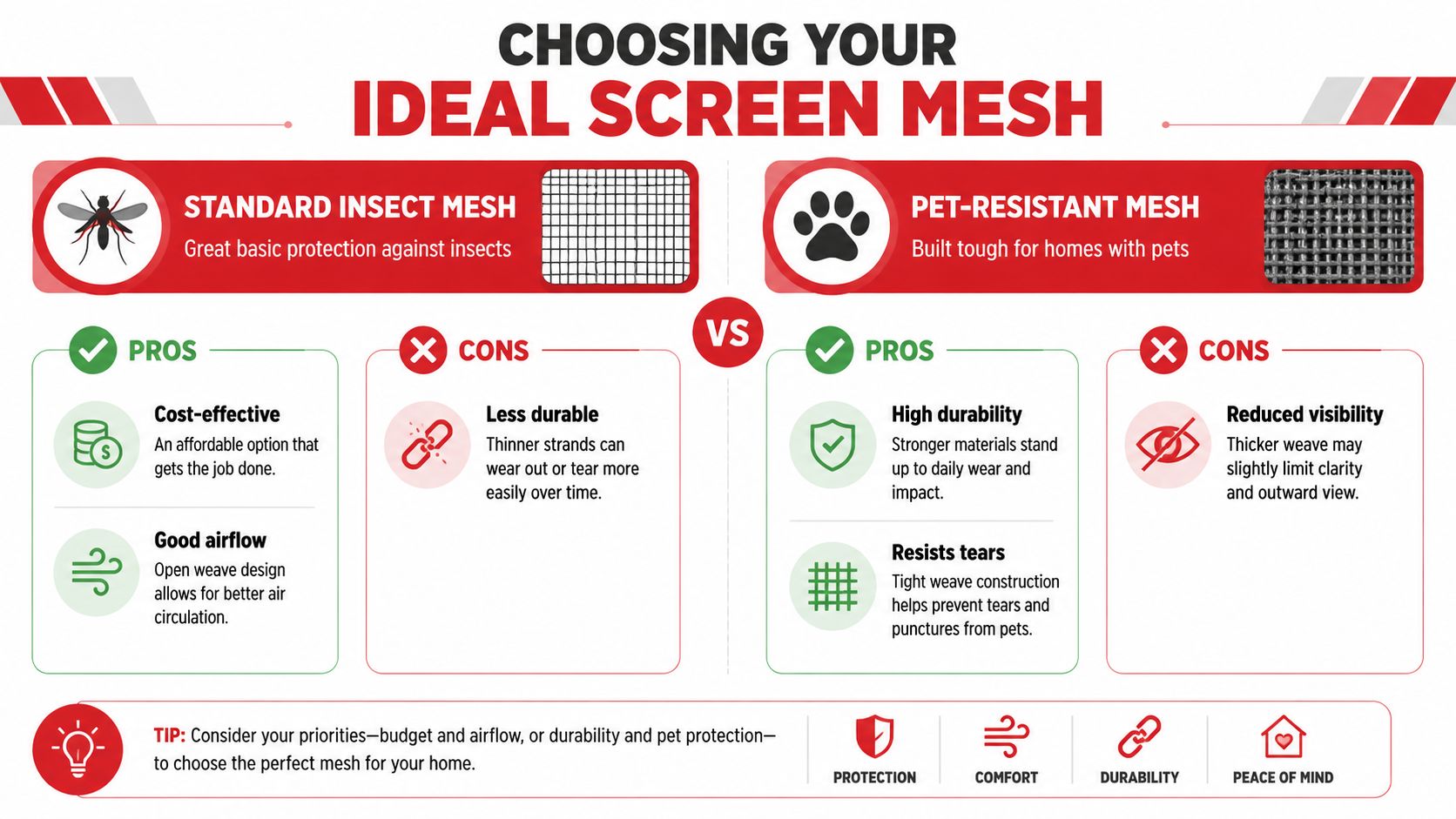
Most buying mistakes happen at the mesh stage. People focus on the frame colour or the opening size, then choose the mesh as if it's all the same. It isn't. The core decision is how much airflow, visibility, and filtration you're willing to trade against each other.
That trade-off matters more than any sales phrase. The mesh-choice guidance discussed here makes the core point clearly: the key decision for buyers is balancing airflow against filtration, and the mesh you choose directly affects how the screen performs.
Start with the problem you're actually solving
If your main aim is general insect control on a kitchen door, standard insect mesh is often enough. If you live near water, trees, or midge-heavy areas, you may need a finer mesh. If hay fever is the issue, you should think differently again and look at specialist options such as pollen mesh.
That's why the right question isn't “Which mesh is best?” It's “What am I trying to keep out, and what am I willing to give up to do that?”
A practical comparison
| Mesh type | Usually suits | Main advantage | Main compromise |
|---|---|---|---|
| Standard insect mesh | Everyday homes, doors, windows | Good general balance | Less specialised |
| Fine midge mesh | Smaller biting insects, exposed areas | Better exclusion of finer pests | Airflow and visibility can feel more restricted |
| Pet-resistant mesh | Homes with dogs or cats near the opening | Better resistance to scratching and pushing | Can look heavier |
| Pollen mesh | Allergy-sensitive households | Helps address airborne irritants alongside insect control | You need to accept a filtration-first approach |
| Stainless steel mesh | Commercial and harder-use settings | Durability and cleaning resilience | More functional appearance |
What homeowners often get wrong
A common mistake is over-specifying the mesh for a low-risk opening. If you fit the densest mesh everywhere, you may end up with rooms that feel more closed in than you expected. The opposite mistake also happens. A standard mesh on a midge-prone site can leave the customer wondering why they bothered.
The smart approach is to decide opening by opening. The kitchen window above the sink might need one answer. The bifold onto the garden might need another. A rear utility door used all day may call for durability first.
On-site reality: Mesh choice changes how the whole screen feels. The finer and tougher the mesh, the more you notice it in operation and in the view through it.
For family homes
Standard insect mesh is often the easiest fit for family use because it keeps the screen feeling light and usable. If pets regularly scratch at the lower section of a door screen, pet-resistant mesh can be the better long-term choice even if it looks a touch more sturdy.
For allergy-sensitive homes, pollen-focused screening is worth considering where ventilation matters most, such as bedrooms and living areas used during warmer months. It won't be the right answer for every opening, but it can make more sense than treating the entire house as one identical screening job.
For food preparation and commercial use
Commercial spaces usually need a tougher, more practical mindset. The priority is reliable exclusion, straightforward cleaning, and materials that suit the working environment. In these settings, the neatest-looking mesh isn't always the most useful one.
For food prep, back-of-house access, and high-use service routes, the screen has to stand up to repeated use and cleaning without becoming a weak point in the hygiene routine. That's why material choice in commercial work should be tied directly to use, not just appearance.
A simple way to decide
Use this order:
- Identify the nuisance. Flies, midges, pollen, pets, or heavier-duty traffic.
- Decide what matters most. View out, airflow, durability, or filtration.
- Match the mesh to the opening. Don't assume every screen in the property needs the same material.
- Check maintenance expectations. Some meshes are more forgiving in everyday cleaning and handling than others.
People usually regret a mesh choice when they've bought for appearance alone. They rarely regret a mesh choice that reflects how the opening is used.
Applications for Residential and Commercial Spaces
Retractable screens work across both homes and businesses, but the reasons for choosing them are different. In residential work, the brief is usually visual first and functional second. In commercial work, it's often the reverse.
For homes, the screen needs to feel integrated. It should sit comfortably on timber, aluminium, or uPVC without looking like an afterthought. That matters especially on renovation projects where original detailing is part of the appeal. If you look at a project like this Victorian townhouse renovation in Wimbledon, you can see why add-ons have to be handled carefully. Openings with character don't tolerate clumsy aftermarket hardware.
Residential use
A made-to-measure screen can suit:
- Kitchen windows where the opening stays in use during cooking
- Bedroom windows where night ventilation matters
- French doors and patio doors where the screen needs to disappear when guests are moving through
- Garden-facing openings where preserving the view is part of the point
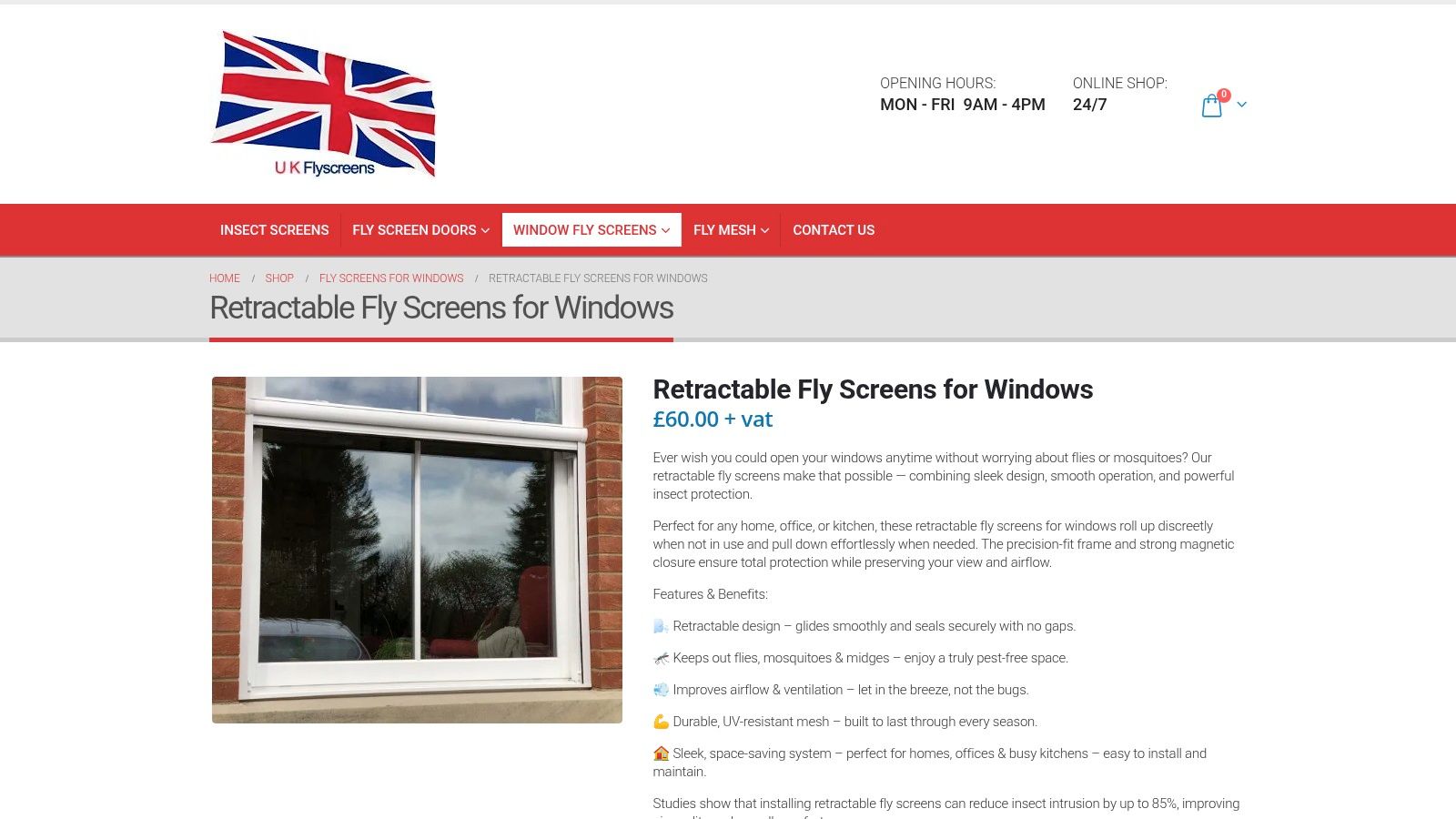
This is the kind of domestic application where a product such as Retractable fly screens for windows fits naturally, because the appeal is in having the screen available when needed without making the window look permanently screened.
Here's the sort of window application many buyers are trying to achieve.
Commercial use
Commercial spaces ask harder questions. Will staff use it properly? Will the screen cope with repeated traffic? Can it be cleaned without fuss? Does the opening need a retractable screen at all, or would another screened access solution suit better?
In kitchens, prep spaces, hospitality sites, and service areas, the right answer often depends on traffic pattern rather than aesthetics. A retractable unit can work well where access is regular but controlled. On very busy thresholds, operators sometimes need a different style of barrier designed around constant movement.
That's why the application has to lead the product choice. A family patio door and a back-of-house delivery entrance might both need insect control, but they do not need the same screen.
A Practical Guide to Measuring and Installation
Most failed retractable screen jobs don't fail because the idea was wrong. They fail because the opening was measured casually, or because the installer assumed a frame was square when it wasn't.
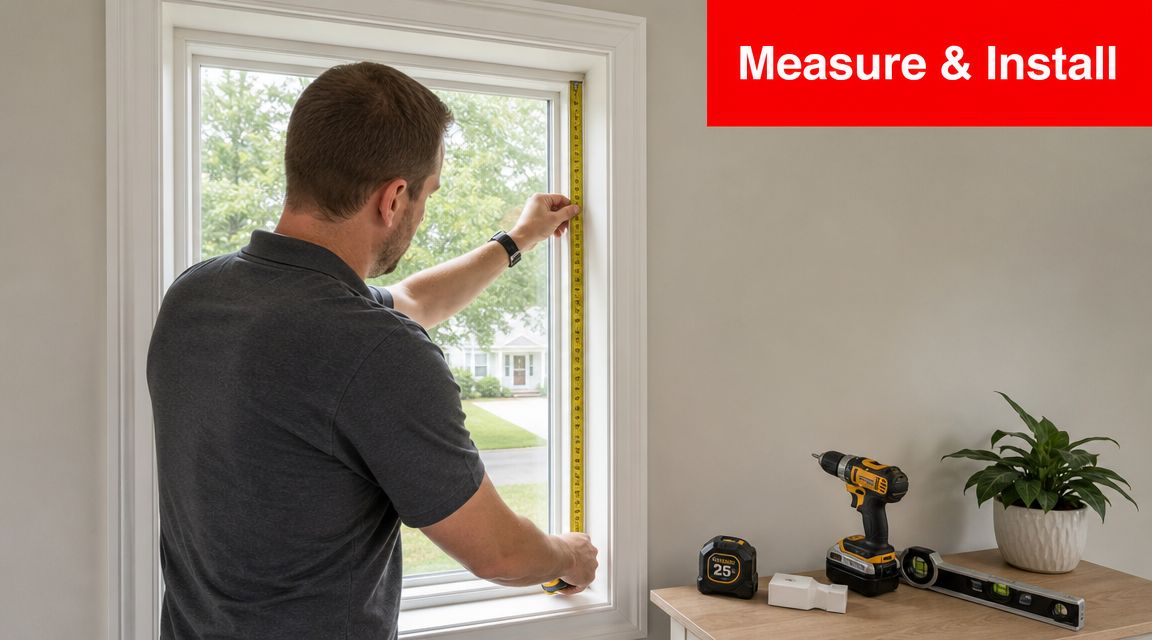
The fitting question matters more in the UK than many generic guides admit. Older properties often have patched plaster, uneven timber, replacement windows inside old reveals, and frames that are visually straight but not parallel. The installation guidance referenced here is useful because it deals with real tolerances: a retractable system may need about 50 mm of frame depth for the cassette, and frames can be out of square by up to 6 mm before packing is needed.
Recess fit or face fit
A recess fit places the screen within the opening. This usually gives the cleanest appearance, but it only works if the reveal depth and internal clearances are good enough.
A face fit mounts the screen onto the surface around the opening. It's often the better answer where the recess is shallow, the frame shape is awkward, or there are handles and trims that would interfere with the screen run.
Choose recess fit when:
- The reveal is deep enough
- The opening is reasonably square
- You want the most discreet final look
Choose face fit when:
- The internal depth is tight
- The opening has irregular edges
- You need to clear projecting ironmongery or trims
How to measure properly
Take more than one measurement. That sounds obvious, but it's the step most likely to be rushed.
Use this sequence:
- Measure width at top, middle, and bottom. Openings often taper.
- Measure height on both sides and through the centre. One head or sill can be out.
- Check the diagonals. If they differ noticeably, the frame isn't square.
- Look at the fixing surface. A screen can only run well if the guides mount to something consistent.
- Check handle clearance and threshold detail. Doors fail in these small areas more often than in the obvious ones.
What causes trouble on site
In real homes, the difficult bits are rarely the overall size. They're the surrounding details.
| Site condition | Why it matters | Likely response |
|---|---|---|
| Shallow frame depth | Cassette may not sit cleanly | Consider face fit or a different screen type |
| Out-of-square opening | Guides may need packing to run true | Survey carefully before ordering |
| Mixed materials | Timber, plaster and uPVC move and fix differently | Plan fixing points before fabrication |
| Uneven threshold | Bottom guide can become awkward or visible | Decide early how the threshold will be handled |
If you can't identify a clean, continuous fixing line for the cassette and guides, stop measuring and reassess the mounting method.
When DIY is realistic and when it isn't
DIY can work on straightforward openings. A modern, square door set with enough depth and no awkward trims is usually manageable for a careful person who measures accurately.
DIY becomes risky when the opening is visibly uneven, the reveal is shallow, or the frame material changes across the fixing line. That's common in older homes where replacement windows sit within original timber or masonry surrounds. It's also where bespoke manufacture earns its keep, because the screen can be designed around the opening you have.
In some cases, a retractable option isn't the right answer at all. On utility doors, side passages, or more functional thresholds, something like chain fly screens for doors may be more appropriate if the opening sees frequent in-and-out use and appearance matters less than constant access.
The clean-fit test
Before you order, ask yourself three blunt questions:
- Does the opening have enough depth for the cassette?
- Can the guides be mounted straight without obvious packing showing?
- Will the finished screen look intentional, not improvised?
If the answer to any of those is no, don't force the retractable screen to do a job the opening won't support. Change the mounting method, change the specification, or change the product type.
Maintaining Your Screens and Choosing a Bespoke Solution
Retractable screens don't need constant attention, but they do reward basic care. Most problems come from dirt in the guides, rough handling, or leaving the screen to deal with misuse for too long.
Simple maintenance that makes a difference
Keep the tracks and guide channels free of grit and debris. If dirt builds up there, the screen starts dragging, and users tend to pull harder, which only makes the wear worse.
Clean the mesh gently. Use a soft cloth or soft brush and avoid treating it like an exterior scrub job. The aim is to remove dust and light grime without distorting the mesh or stressing its edges.
A few sensible habits help:
- Retract the screen properly when it's not needed, rather than leaving it exposed for no reason.
- Operate it from the handle or pull bar instead of grabbing the mesh itself.
- Check the rails occasionally for buildup, especially after pollen-heavy or dusty periods.
- Deal with small running issues early before they turn into misalignment or edge wear.
Why bespoke usually outperforms off-the-shelf in the UK
Off-the-shelf products can work on simple, regular openings. The problem is that many UK openings aren't simple or regular. They may be slightly twisted, have limited depth, or combine old and new materials in one frame.
That's why bespoke screens usually give a better result here. The frame size, mounting method, mesh type, and operating format can be chosen for the actual opening rather than the idealised one shown on packaging. For awkward timber reveals, deep-set brick openings, and mixed renovation details, that difference shows up immediately in how the screen looks and runs.
A bespoke approach also lets you match the screen to the opening's real job. A pollen-focused bedroom window, a pet-exposed kitchen door, and a harder-working service entrance rarely benefit from the same specification.
Buy for the opening you have, not the opening you wish you had.
If you want a made-to-measure option, Premier Screens Ltd manufactures bespoke fly screens for UK homes and businesses, including retractable formats, with mesh choices suited to domestic and commercial use.
If you're weighing up fly screens retractable for a specific window, patio door, kitchen entrance, or commercial opening, Premier Screens Ltd is a practical place to start. They manufacture bespoke fly screens for UK properties, and that matters when your frame isn't perfectly standard, your mesh needs are specific, or you want advice on whether a retractable system is the right fit at all.