
Industrial Door Solutions: A UK Facility Manager’s Guide
A typical shift starts with three complaints arriving at once. The prep area is running too warm, a back door keeps letting insects in during deliveries, and the last service note says the powered shutter is overdue for inspection. If you're the person responsible for the site, you don't get to solve those issues one at a time. You have to solve them together.
That's why industrial door solutions matter far beyond access. In a UK food unit, retail stockroom, surgery, pharmacy, warehouse, or mixed-use commercial building, the door line sits right at the pressure point between hygiene, safety, temperature control, and workflow. Choose badly and staff prop doors open, pests find a route in, inspections become stressful, and maintenance costs creep up. Choose well and the door becomes part of the process, not a recurring problem.
Introduction The Daily Challenge of Site Access and Control
A new operations manager often inherits the same awkward setup. Deliveries come through one opening, staff use it as a shortcut, heat escapes every time it opens, and somebody has tried to fix insect problems with a temporary screen that doesn't close properly. On paper, those are separate issues. On site, they're one problem.
In most facilities, the right answer isn't a generic “fit a stronger door”. It's matching the opening to the task. A goods-in bay needs something different from a customer-facing rear service entrance. A kitchen pass-through has different priorities from a cold-room threshold. That's why practical industrial door solutions usually combine door type, screen type, operating method, and maintenance planning.
Rolling doors already dominate high-traffic environments. Rolling doors account for 38% of all total industrial door installations, followed by sliding doors at 27%, which is why they're such common starting points for food preparation and commercial settings where insect control also matters (industrial door installation market data). The prevalence makes sense. They suit repetitive movement, compact footprints, and busy service routes.
Practical rule: Start with the operational bottleneck, not the catalogue. Ask what the opening must prevent, what it must allow, and what happens when it fails.
That last point is where managers often get caught out. A door can look serviceable and still be the weakest part of the site's control plan. If your team is also reviewing servicing schedules, shutdown planning, and asset criticality, it helps to treat doors the same way you treat any other reliability-sensitive equipment. A useful reference point is this guide to industrial maintenance reliability, because the same discipline applies. Failure prevention beats reactive fixes.
An Overview of Industrial Door Solutions
Not every opening needs a powered industrial door. Some need airflow with barrier control. Some need impact tolerance. Some need quick pedestrian access without creating an open invitation for pests. The practical choice usually comes down to three broad options.
PVC strip curtains
PVC strip curtains are the simplest functional barrier in many industrial settings. Overlapping flexible strips let people, trolleys, and light equipment pass through without a full opening cycle. They're common where speed matters more than a hard seal and where visibility through the opening still matters.
They work well in internal separations, loading transitions, and back-of-house routes where staff move constantly and won't reliably close a hinged screen behind them. Their weakness is that they're not ideal where a close-fitting perimeter seal is the core requirement, or where presentation matters.
A good starting reference for the format is PVC strip curtain doors. The key point isn't the product page itself. It's the operating principle: low-friction access, simple replacement of worn strips, and a practical compromise between movement and separation.
Chain fly screens and mesh barriers
Chain fly screens suit service openings and pedestrian routes where airflow is valuable and a visible deterrent to flying insects is enough for the task. They're commonly used where a full solid door would hinder traffic and where staff need to pass through by hand without operating hardware each time.
Their strength is convenience. Their limitation is obvious too. They don't offer meaningful temperature control, and they don't create the same close-fitting edge control you get from a framed screen door. In a site with strict hygiene requirements, chain systems are often better as a secondary control rather than the only line of defence.
Heavy-duty framed screen doors
Heavy-duty aluminium-framed screen doors with stainless steel mesh sit at the more durable end of the spectrum. These are usually the right fit where the opening has to cope with repeated use, cleaning routines, moisture, and a need for controlled ventilation without pest ingress.
They're a sensible option for food areas, healthcare back-of-house routes, and hospitality sites that need a more sturdy, more formal barrier than chains or strips. In some lighter-use commercial settings, Retractable insect screen doors can also be relevant, especially where the opening serves mixed purposes and the screen needs to be out of the way when not in use.
A door that staff can't use easily won't stay in service properly. Convenience is part of compliance.
Industrial Door Solutions Comparison
| Solution Type | Best For | Pest Control | Temperature Control | Durability |
|---|---|---|---|---|
| PVC strip curtains | Internal transit routes, loading transitions, frequent trolley traffic | Moderate | Moderate | Good in busy traffic, but strips wear and need replacement |
| Chain fly screens | Pedestrian routes, service openings, warm-weather ventilation | Basic to moderate | Low | Moderate, depends on traffic and fixing quality |
| Heavy-duty aluminium doors with stainless steel mesh | Food prep routes, healthcare back-of-house, high-use commercial openings | High | Low to moderate, depending on surrounding door arrangement | High |
What works and what doesn't
A few patterns show up repeatedly on site:
- What works: Matching a simple system to a simple task. Strip curtains on constant trolley routes often outperform more complex doors because staff use them.
- What doesn't: Using chain screens where audit pressure is high and a tighter seal is needed around the frame.
- What works: Specifying framed mesh doors where washdown, repeated opening, and pest control all matter.
- What doesn't: Treating every external opening as if it needs the same solution.
Matching the Right Door to Your Business Environment
The fastest way to make a poor buying decision is to ask, “What's the best industrial door?” There isn't one. There's only the best option for your traffic pattern, hygiene risk, and building layout.
Food preparation and commercial kitchens
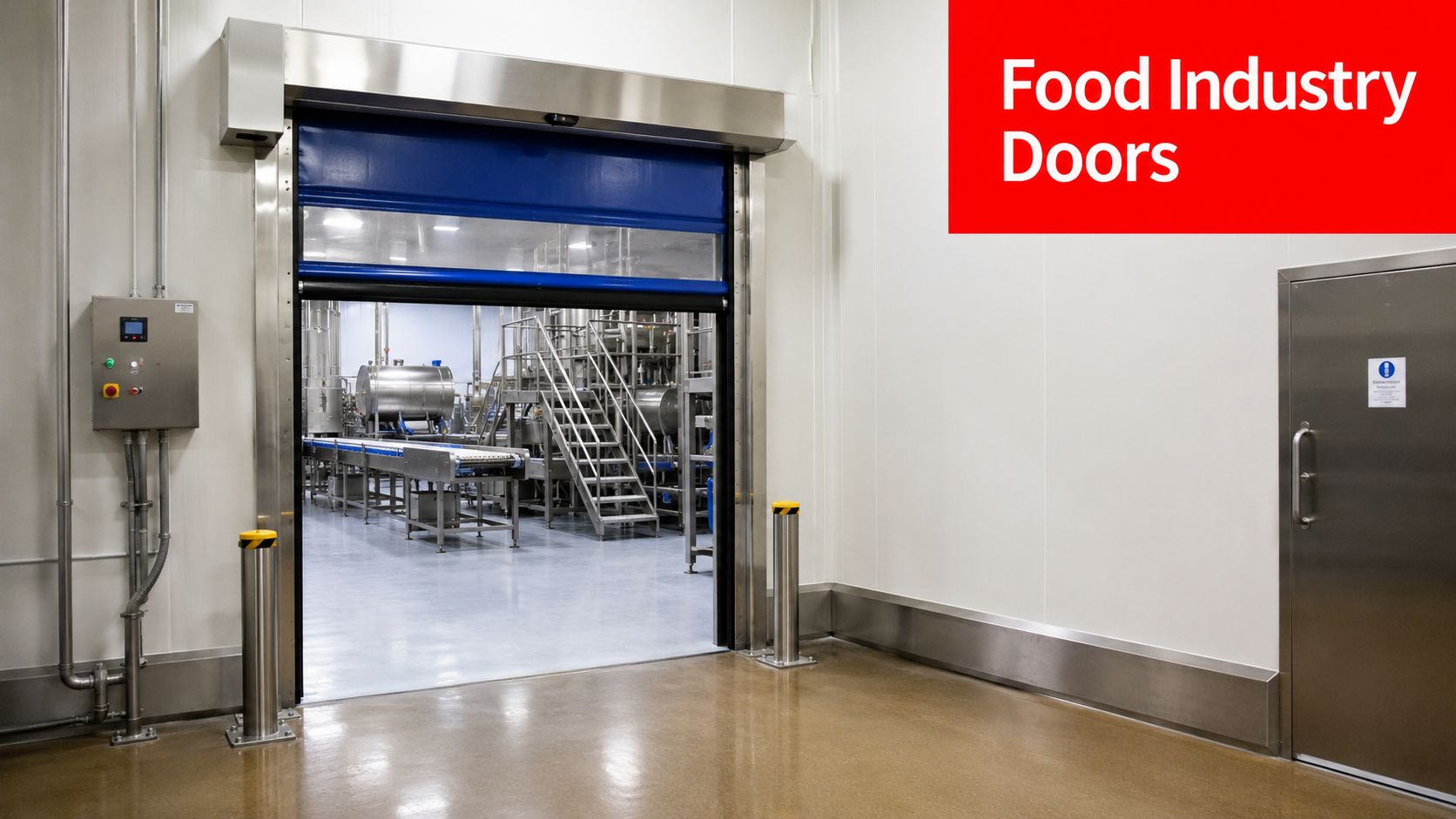
Food prep areas need two things at the same time. They need reliable movement of people and goods, and they need a barrier that supports hygiene control instead of undermining it. That usually rules out loose, improvised screening and any arrangement that leaves gaps at the perimeter.
For a kitchen rear entrance or a production-side personnel doorway, a framed screen door is often the practical answer because it gives you a defined opening, repeatable closure, and a proper mesh choice. If you're comparing formats, commercial heavy-duty insect screen doors are the type to look at for this use case. They suit openings where staff movement is regular and the screen has to tolerate knocks, cleaning, and repeated use.
In a goods-in area, the answer may be layered. A main industrial door handles security and environmental separation. A secondary screen solution handles insect control when the main door is open for ventilation or deliveries. That combination works better than asking one product to do everything.
Retail and hospitality sites
Retail stockrooms, cafés, bars, and hospitality venues usually prioritise ease of movement and appearance along with basic pest control. A rear access point that annoys staff will be wedged open within days, so ease of passage matters more here than many buyers expect.
For those sites, think in terms of traffic rhythm:
- Short bursts of heavy movement: PVC strips can make sense between stockroom zones.
- Regular staff-only use: A framed hinged screen often gives cleaner control.
- Seasonal ventilation needs: A lighter screen format may be enough if the opening isn't the main operational route.
Where customer perception matters, the neatness of the installation counts. A crooked retrofit or bulky frame at a visible service entrance creates needless friction with both staff and visitors.
Healthcare and controlled environments
Healthcare facilities don't all need the same door strategy. A plant room opening has very different demands from a catering access point or pharmacy support area. But one rule applies widely: avoid solutions that create hard-to-clean surfaces, uncertain closure, or vague responsibility for maintenance.
In these settings, the specification should focus on close fit, durability, and ease of inspection. Staff need to see quickly whether the barrier is intact and functioning. The more a solution depends on “being careful”, the less dependable it becomes over time.
If a site relies on memory rather than design, the control measure won't hold up under pressure.
A simple selection test
Use this sequence before you approve anything:
- Define the opening's real job. Is it for deliveries, staff passage, ventilation, contamination control, or all four?
- Watch the traffic for a day. The route people use is often different from the route on the plan.
- Check who must operate it. Cleaners, kitchen porters, retail staff, patients, and delivery drivers all use doors differently.
- Specify for misuse as well as correct use. Assume someone will push, kick, prop, overfill, or rush through it.
- Match the barrier to the consequence of failure. In a food area, a poor seal matters more than in a general service corridor.
Navigating UK Compliance and Hygiene Standards
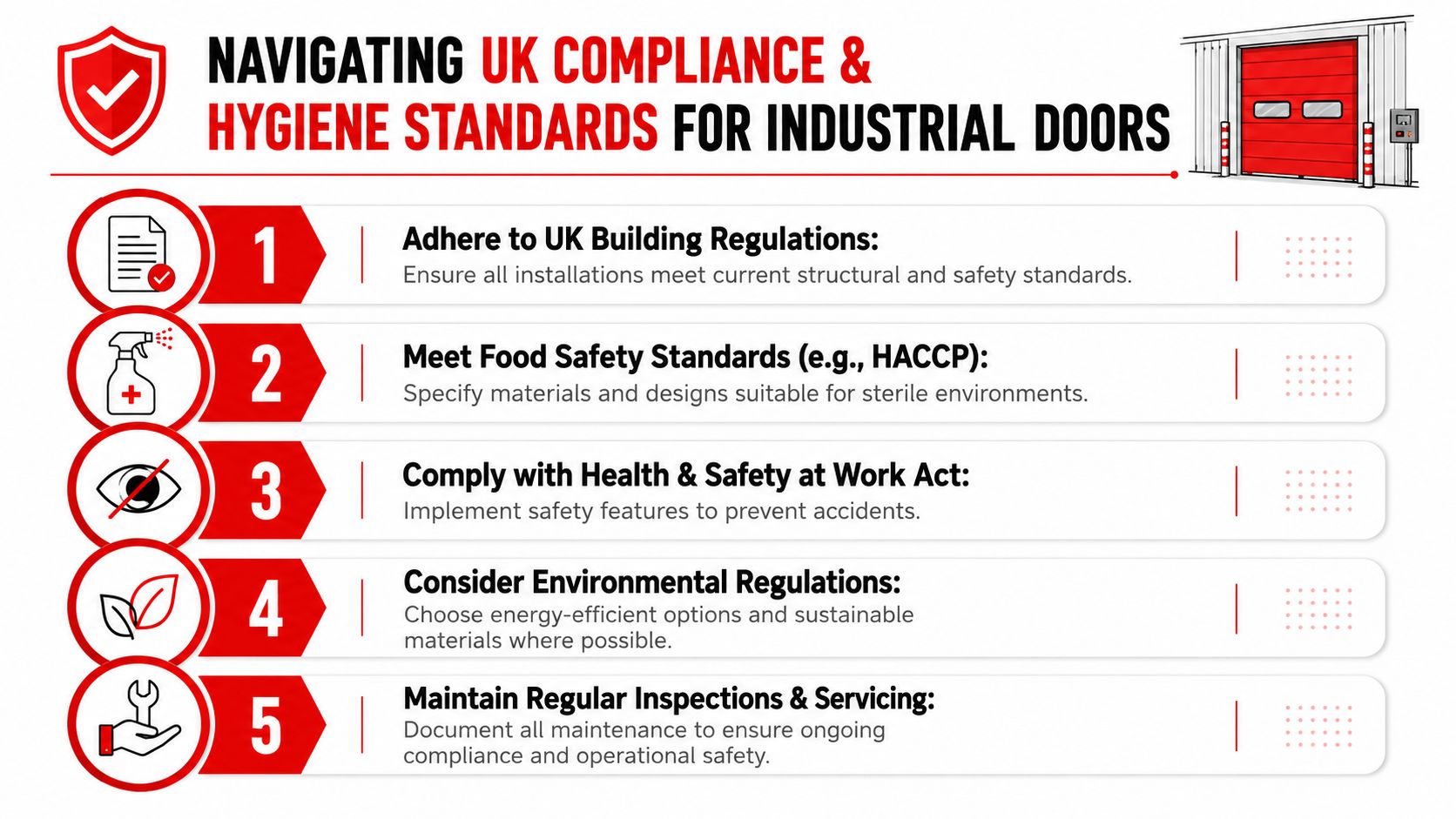
Compliance is where industrial door solutions stop being a buying decision and become a management responsibility. If the opening forms part of your hygiene control, your choice has to stand up to inspection, daily use, and maintenance reality.
What the law expects from the door itself
Under the Workplace (Health, Safety and Welfare) Regulations 1992 requirement for safe and maintained industrial doors, employers must ensure workplace doors are safe for use and appropriately maintained. That's the baseline. If a powered or automated door is in service, it isn't enough for it to open and shut. It has to do so safely, consistently, and with servicing records to support that.
For powered vertically moving doors, the detail matters. The revised BS EN 12453 and BS EN 12604 standards highlighted by HSE require effective measures to detect suspension failure and prevent unintended movement beyond 300 mm. That threshold exists because uncontrolled drop is a serious hazard, not a paperwork issue.
There's another structural point buyers sometimes miss. BS EN 12604 anti-drop device requirements for industrial and commercial doors mandate anti-drop devices on relevant industrial, commercial, and garage doors. If you're replacing or retrofitting a heavy-duty opening, confirm the protection method in writing.
What food-site inspections focus on
Food sites add another layer. The practical concern isn't only whether insects can enter. It's whether your chosen screen suits the opening, closes properly, and supports hygienic operation day after day. That's where many facilities fall short.
Recent 2025 UK Food Safety Authority reports highlight a 22% increase in non-compliant screening in food prep zones due to inadequate insect mesh selection, and the same source notes that major industrial door suppliers don't offer region-specific installation data for FSA-aligned fly screens (food prep screening compliance gap in the UK). The practical implication is simple. You can't assume a generic “fly screen” specification will satisfy the demands of a busy food environment.
A few checks make a difference:
- Perimeter fit: Inspectors will notice gaps faster than they notice product labels.
- Mesh suitability: Fine enough for the pest risk, but not so restrictive that staff defeat the system by leaving doors open.
- Cleanability: Frames, hinges, and fixings must tolerate routine cleaning.
- Closure behaviour: The barrier has to return to the shut position reliably.
Where airflow is useful but the opening doesn't justify a full framed unit, chain fly screens for doors can play a role in lower-risk routes. They shouldn't be treated as a universal answer for high-control food prep openings. Likewise, Magnetic Fly Screens are a window solution, not a substitute for a properly specified industrial doorway barrier.
Understanding Mesh Options and Material Durability
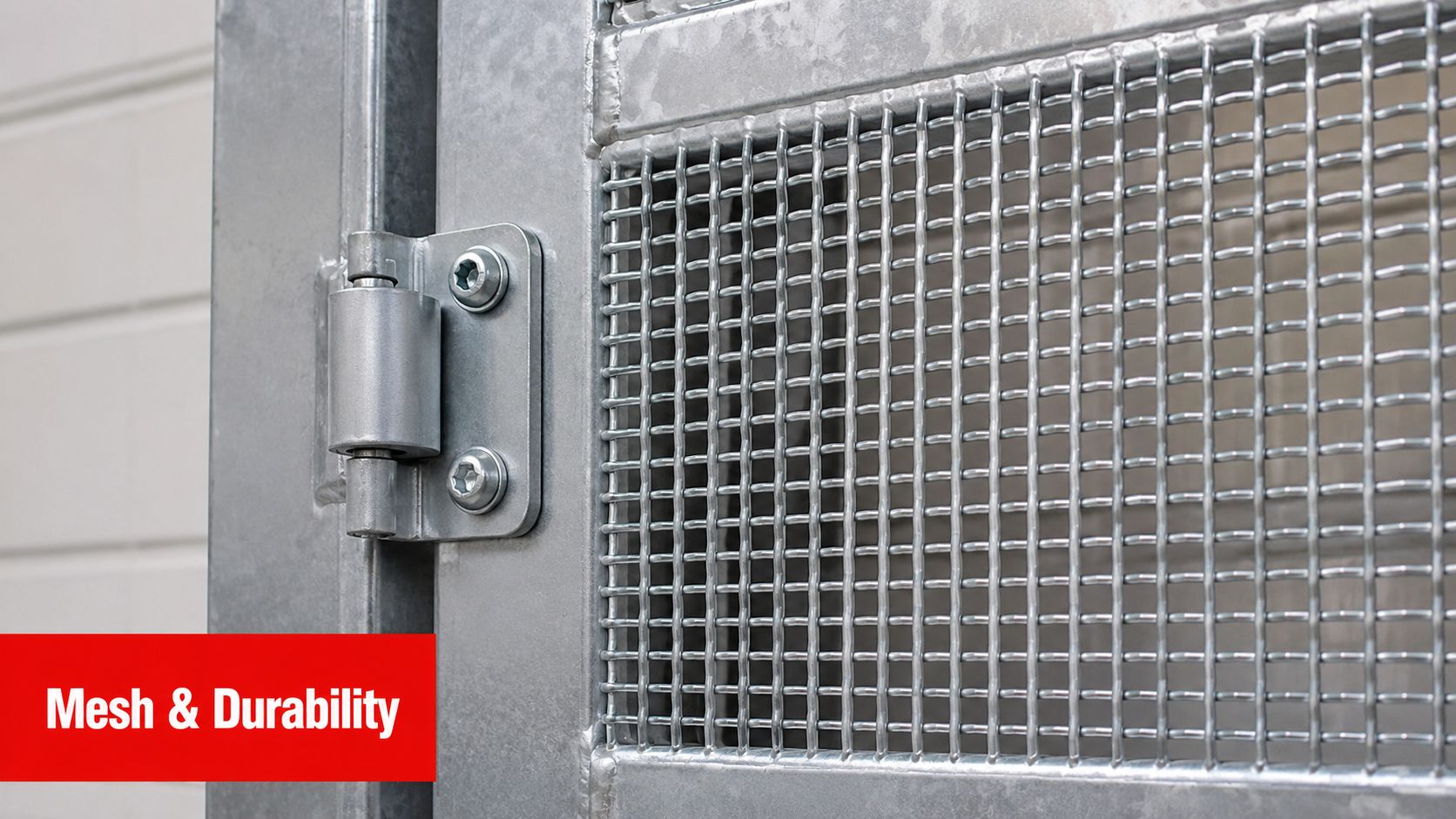
Mesh selection decides whether a screened opening works on a live site or becomes another item on the maintenance list. The frame matters, but in food prep rooms, washdown areas, and older buildings with irregular openings, the mesh, edge retention, and fixings usually determine day-to-day performance.
Choose mesh by operating risk
Standard insect mesh suits many service doors, warehouses, and general commercial routes where the goal is simple flying insect control with reasonable airflow. It is often the right answer, but not automatically the right specification.
Food businesses need a tighter brief. In prep and production areas, the screen has to support hygiene control without creating a cleaning problem or restricting airflow so badly that staff bypass it. Fine mesh can help where smaller insects are a known issue, especially on rural sites or near standing water, but tighter apertures can reduce air movement. That trade-off matters in hot kitchens and back-of-house spaces.
Pollen mesh solves a different problem. It helps where ventilation is still needed but airborne allergens affect staff comfort. For openings that get knocked by bins, trolleys, cages, or repeated hand contact, impact resistance matters more than mesh type alone. A good-spec mesh in a weak retention channel will fail early.
I see this mistake regularly on retrofit work. Buyers focus on the nominal mesh grade, then inherit sagging corners, torn edges, or distorted frames because the existing opening was uneven and the fixing method was wrong for the substrate.
Material durability starts with the environment
Wet rooms, kitchens, loading routes, and plant areas all age materials differently. Aluminium frames are usually the sensible base choice for UK commercial sites because they handle moisture and routine cleaning better than poorly protected steel. In more aggressive environments, stainless steel mesh and corrosion-resistant fixings are often worth the extra spend because they cut replacement frequency and help maintain a cleanable finish.
Sun exposure matters as well. Mesh fitted on south-facing or unshaded elevations can become brittle if it is not UV-stable. The failure does not usually start with a dramatic tear. It starts with stiffness, edge cracking, and panels that no longer sit flat in the frame.
Hardware deserves the same scrutiny. Hinges, closers, retention strips, corner joints, and bottom rails often fail before the main frame does. On busy routes, that is what turns a sound specification into a nuisance callout.
Durable installations come from matching mesh, frame, and hardware to the opening, the washdown routine, and the traffic pattern.
Retrofits and older buildings need more care
Many generic guides stop short of addressing these real-world challenges. Existing stock rarely gives you a perfect square opening, dry masonry, and clear fixing zones. Older industrial units and heritage conversions often have uneven reveals, shallow returns, fragile substrates, or previous alterations that limit frame depth and fixing positions.
That affects mesh performance directly. If the frame twists during installation or the opening has inconsistent gaps, the screen will not seal cleanly and the mesh will carry stresses it was never meant to carry. In FSA-sensitive areas, that is more than a durability issue. It can become a hygiene and inspection problem.
Practical specification points
- For food prep and washdown areas: choose cleanable frame finishes, corrosion-resistant fixings, and mesh that meets the insect risk without making the space uncomfortable to work in.
- For older or irregular openings: ask for made-to-measure frames and confirm how the mesh will be retained if the substrate is uneven or weak.
- For sunny elevations: specify UV-stable mesh to avoid early brittleness and shrinkage.
- For impact-prone routes: check hinge grade, kick protection, and how the mesh is tensioned and secured at the edges.
- For allergy-sensitive spaces: use pollen mesh only where that need is real, because it solves a different problem from insect exclusion.
Your Specification and Installation Checklist
A good specification prevents half the installation problems before anyone arrives on site. Most failures come from one of three causes: bad measurements, bad assumptions about use, or no serious thought about the existing structure.
Start with the opening you actually have
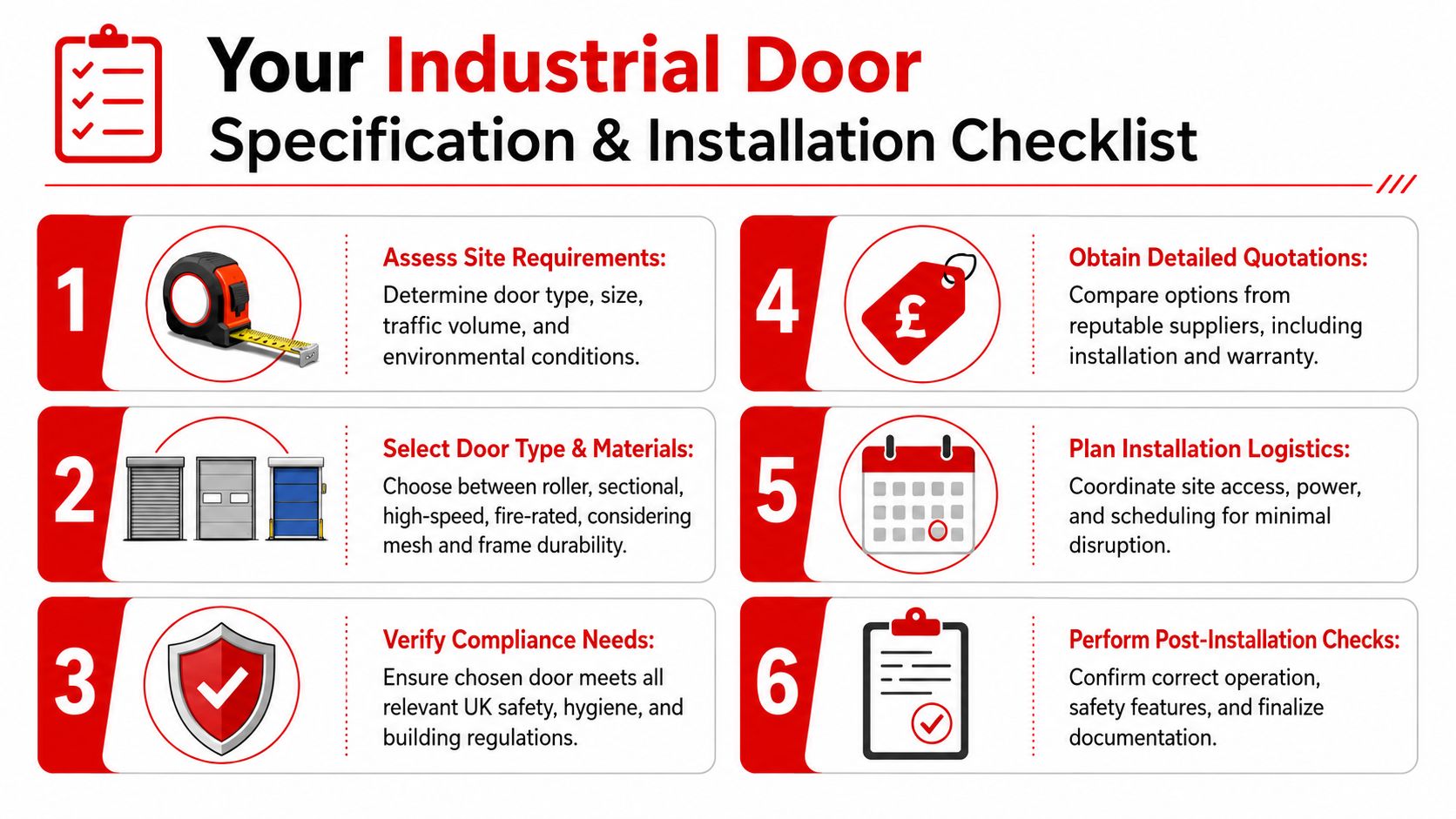
Don't rely on old plans. Measure the clear opening, side room, headroom, threshold condition, and the substrate you're fixing into. Then check for pipework, cable runs, damaged lintels, uneven reveals, and any route conflict with existing doors, shutters, or fire equipment.
That matters even more in older stock. Current content on industrial doors often ignores the 18% of UK industrial sites located in converted heritage properties, where made-to-measure aluminium frames and UV-stable meshes are often necessary because standard units won't suit irregular openings. In practice, heritage and adapted commercial buildings usually need more surveying and more tolerance planning.
Use this checklist before ordering
- Confirm the site function: Write down whether the opening is controlling pests, temperature, security, pedestrian flow, trolley traffic, or a mix.
- Record traffic type: Note who uses it and what passes through. Staff on foot, roll cages, pallet trucks, and bins all change the right answer.
- Check the fixing surface: Masonry, steel, UPVC, and timber each need a different installation approach.
- Review cleaning exposure: Kitchens and prep areas need frames and hardware that stand up to frequent wipe-downs.
- Specify closure behaviour: Don't assume “self-closing” means suitable. Ask how it behaves in constant use.
- Plan maintenance access: Hinges, tracks, mesh panels, and fixings should be inspectable without dismantling half the opening.
Retrofitting older and non-standard buildings
Retrofitting gets harder when the existing opening isn't square, when the threshold has settled, or when previous repairs have left mixed materials around the frame. That's common in older workshops, hospitality conversions, and sites with timber or UPVC secondary structures.
In those cases, ask for a fixing method that suits the substrate and for a frame build that can accommodate minor irregularity without leaving visible gaps. This is also the point where direct manufacture can help because made-to-measure fabrication avoids forcing a standard-size product into a non-standard opening. If you're looking at procurement routes beyond single-site purchase, reviewing UK door installation public tenders can also help facilities teams understand how larger organisations structure specifications and scope installation requirements.
A practical example fits here. Premier Screens Ltd is one option for made-to-measure screening on existing UPVC or timber openings, including heavy-duty aluminium door formats and custom mesh selections. The point isn't the brand name. It's the delivery model: custom sizing is often the difference between a clean retrofit and a compromised one.
Evaluating Cost Durability and Long-Term ROI
A door that saves £800 on purchase price can cost far more within the first year if it slows traffic, loses heat, fails inspections, or needs repeated repairs. That is the usual pattern on busy UK sites.
ROI starts with the cost of the opening in use, not the cost on the quote. Look at cycle frequency, cleaning demands, exposure to moisture or impact, and what happens when the door is left open or taken out of service. In a food prep area, the wrong door and mesh combination can create extra cleaning time, pest risk, and compliance problems. In an older building, poor retrofit detailing often shows up later as frame movement, air gaps, and repeated adjustment visits.
Thermal performance can justify a higher-spec door where internal temperatures matter. As noted earlier, insulated industrial shutters can reduce heat loss and cut annual HVAC costs in the right setting. That matters in production rooms, dispatch areas, and mixed-use buildings where staff work close to external openings for long periods.
Durability decisions should be tied to failure points. Tracks, hinges, seals, bottom rails, mesh retention, and closer performance usually decide whether a system lasts. Cheap components wear fastest in the parts staff touch every day. The result is predictable. More callouts, more downtime, and more workarounds by site teams.
Retrofitting changes the maths as well. A made-to-measure installation on an older or heritage property often costs more upfront, but forcing a standard unit into an irregular opening usually leads to visible gaps, poor sealing, and shorter service life. Paying for proper survey work and fabrication is often the lower-cost choice over five to ten years.
The return is rarely one dramatic saving. It usually comes from fewer breakdowns, lower heat loss, cleaner operation, and less management time spent chasing avoidable defects.
If you're reviewing openings across a food site, hospitality venue, healthcare facility, or mixed commercial building, Premier Screens Ltd is a practical place to start for bespoke fly screens and industrial door screening options. Their range includes made-to-measure solutions for high-traffic commercial use, including heavy-duty aluminium doors, chain screens, and PVC strip curtain formats, which can help when you need to balance airflow, insect control, and day-to-day usability.