

Mesh Covers for Air Bricks: Pest & Damp Solutions
You hear it at night first. A faint scratching behind the skirting, or a dry rustle near a low wall vent you’ve walked past for years without thinking about it. By the time most owners notice that sound, the air brick has already done two jobs. It has let the building breathe, and it has given something else a route into the structure.
That’s why mesh covers for air bricks matter. They aren’t just pest accessories. They’re part of the building envelope. Fit the right cover and you reduce access for rodents and insects while keeping the vent working as intended. Fit the wrong one, or block the opening too aggressively, and you can swap one problem for another.
In UK housing, that trade-off matters more than many people realise. Older homes rely heavily on underfloor ventilation, and a significant share of the country’s housing stock was built before modern construction standards. In that context, air brick protection has to be treated as ventilation management as much as pest proofing.
The Unseen Gateway into Your Home
The call usually comes after the signs have started. Droppings in a kitchen corner. A rustle below suspended timber flooring. Nesting material pulled into a cavity. On inspection, the entry point is often low on the outside wall, at a vent that still looks serviceable until you get close enough to see the split mesh, failed mortar joint, or gap around the frame.
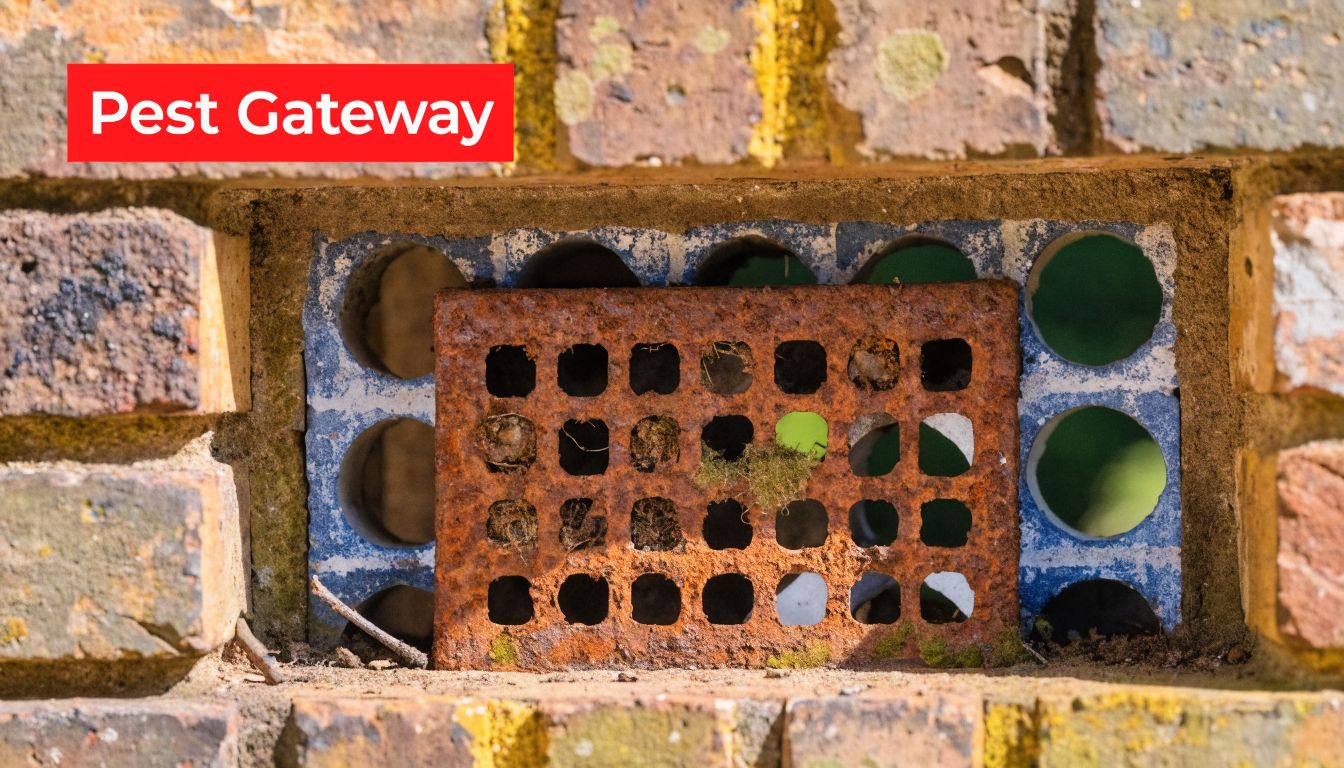
That pattern is common in UK housing because many properties, especially older terraces and houses with suspended floors, still depend on air bricks to keep subfloor voids ventilated. In Victorian and Edwardian stock, the problem is rarely the vent opening alone. It is the combination of age, patch repairs, uneven brick faces, soft mortar, and years of exposure in a wet climate.
An air brick is not a defect. It is part of the building’s moisture-control system. If that ventilation path is blocked too heavily in an attempt to stop rodents or insects, the risk shifts from pest entry to stale voids, trapped moisture, and timber kept damper for longer than it should be.
That is where poor advice causes trouble.
On older properties, I often see one of two mistakes. The first is doing nothing because the original grille looks intact from the pavement. The second is sealing or foaming around the opening as if it were just another gap to close. Neither approach respects how these buildings work.
Why this opening needs a different approach
Air brick protection has to do more than keep pests out. It has to preserve usable airflow, sit securely on imperfect masonry, and cope with real site conditions such as recessed vents, flaking paint, crumbling pointing, and walls that are far from square.
In domestic settings, that balance protects the structure as much as the living space. In commercial food environments, the same balance matters for hygiene and compliance, because low-level vents can become a pest route if left exposed, but they still cannot be blocked without considering the ventilation requirement.
What the opening usually tells you
A quick external check often reveals why a vent has become vulnerable:
- Cracked or corroded face grilles
- Gaps at the edge of old fittings
- Recessed openings that leave side access
- Damaged mortar that prevents a tight fixing
- Previous repairs that reduced the free air area
The last point gets missed regularly. A cover can stop entry and still be the wrong solution if it cuts airflow too far. That is why air brick protection needs to be treated as part pest proofing, part ventilation control, especially in older UK buildings where the margin for error is smaller.
A good result starts with recognising the vent for what it is. It is an access point for pests, but it is also a working part of the building fabric.
Understanding Air Brick Mesh Covers
Think of a mesh cover as a selective bouncer for the building’s breathing holes. Air gets through. Pests don’t. That sounds simple, but good air brick protection is more engineered than many DIY fixes suggest.
A proper cover sits either over the face of the existing air brick or across the surrounding masonry. It combines a support structure, whether that’s a formed cover or a cut sheet, with a mesh screen sized to stop entry without choking the vent.
The two jobs a mesh cover must do
The first job is obvious. It has to stop unwanted access. That includes rodents, insects, and in some locations larger nuisance pests trying to exploit low-level openings.
The second job is less obvious but more important over the long term. It has to leave the ventilation path open enough for the building to keep drying and breathing as designed.
Those two functions can’t be separated. A cover that’s excellent at exclusion but poor on airflow is a bad installation. A cover that ventilates beautifully but bows away from the wall or leaves side gaps is also a bad installation.
What a good setup looks like
Most effective systems fall into one of two types:
| Type | Best use | Limitation |
|---|---|---|
| Purpose-made vent cover | Standard, flat-faced vents with tidy fixing surfaces | Less forgiving on recessed or damaged openings |
| Cut woven mesh fixed to masonry | Older, irregular, or mixed-size vents | Needs more care to cut and secure neatly |
Neither is universally right. The wall tells you which one is sensible.
In practical terms, mesh covers for air bricks also need to cope with weather, debris, and routine maintenance. Outdoor exposure changes everything. Materials that seem acceptable in a sheltered retail pack can deform, corrode, or loosen once they’ve had a few seasons of rain, dust, and thermal movement.
A secure fit at the perimeter matters as much as the mesh in the middle. Most failures happen at edges, corners, or fixings.
Basic forms you’ll come across
You’ll usually see one of these approaches on site:
- Face-fixed covers that sit visibly over the air brick and are chosen to match common vent sizes.
- Woven metal mesh sheets trimmed to the opening with overlap into sound masonry.
- Cavity or recess-mounted barriers used where the outer face is awkward or damaged.
- Framed mesh grilles made to suit a specific opening or finish requirement.
One example of a made-to-measure approach is a product range from Premier Screens Ltd, which offers air brick ventilation covers built around a frame and mesh combination intended to block pests while allowing airflow. That kind of format is useful where a standard off-the-shelf fit won’t sit correctly on the wall.
Key Benefits Beyond Stopping Pests
The search for mesh covers for air bricks often begins with the aim of stopping mice or rats. Fair enough. That’s usually the trigger. But the wider benefits are what justify doing the job properly rather than treating it as a quick patch.
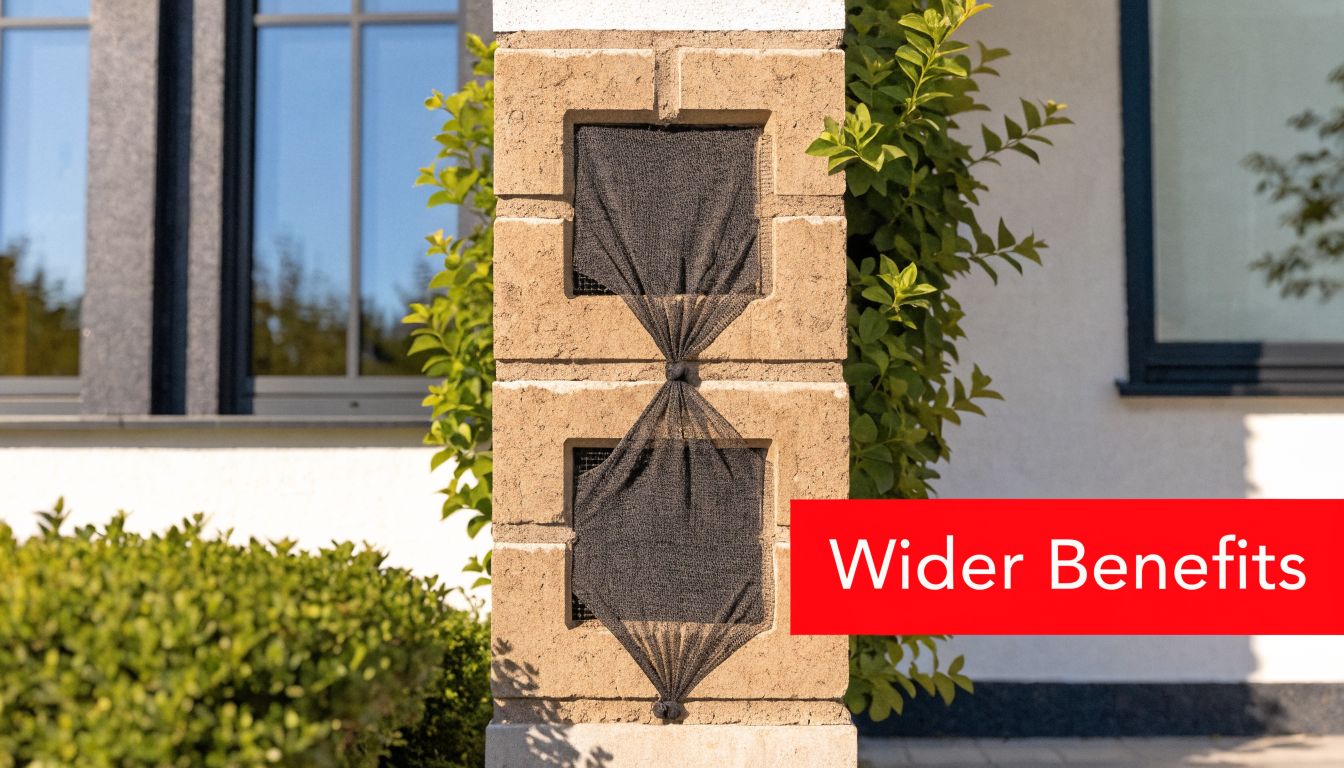
Cleaner pest control
A vent cover deals with one of the few obvious access routes on an external wall. That matters because pests often move into hidden spaces first. Underfloor voids, cavities, service penetrations, and duct routes give them shelter long before anyone sees activity inside a room.
Once that movement starts, the secondary issues pile up. Nesting material collects in voids. Contamination spreads. Other defects become more attractive because the building already has active traffic through it.
A guarded vent won’t solve every infestation on its own, but it removes a direct path into the structure. In pest control terms, that’s a valuable reduction in vulnerability.
Better hygiene in commercial settings
For food premises and commercial kitchens, low-level vents create a constant tension between ventilation and exclusion. Staff need air movement. Managers need barriers that support a pest-free environment.
That’s where mesh covers make practical sense. They help protect service areas, storage zones, and kitchen perimeters without turning ventilation openings into weak points. In customer-facing spaces, they also give a neater and more defensible finish than improvised wire patches or damaged grilles.
Less risk of hidden building damage
Pests don’t just occupy voids. They interfere with them. Once inside, they can foul insulation, disturb debris lines, and exploit routes around pipework and cable penetrations. The damage is often indirect at first. You don’t always see the route. You just see the consequences later.
That links directly to moisture management. If you’re already dealing with condensation or mould risk in the same property, it helps to understand the bigger picture. A good companion resource is this full home guide on preventing mold, which looks at the broader conditions that let moisture problems take hold.
Reduced allergen and insect nuisance
Some owners also want air brick protection because of crawling insects or airborne irritants. Fine mesh options can cut down insect entry and, in some applications, help reduce the passage of larger airborne particles.
That said, finer mesh always introduces an airflow question. If someone’s choosing a screen primarily for allergen control, the ventilation side must be checked with more care than it is in a standard rodent-proofing job.
If the cover solves your pest problem but makes the subfloor damper, the installation has failed. Good proofing protects the building as well as the occupants.
Choosing the Right Mesh Material and Grade
A cover can fit neatly on the day it is installed and still be the wrong specification. I see that most often on older UK housing, where the vent opening is irregular, the wall face is uneven, and the property already has a narrow margin for safe subfloor ventilation.
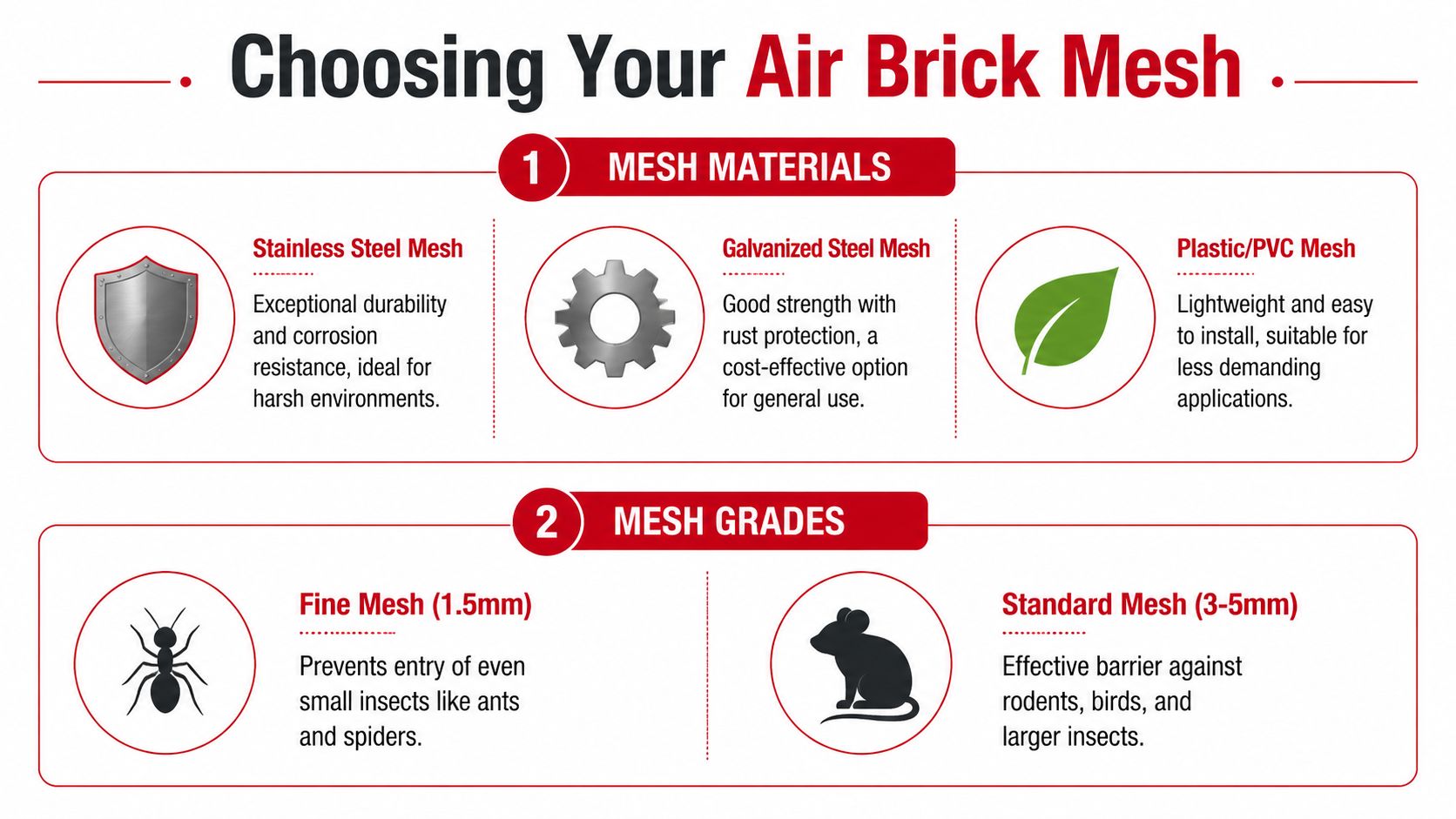
Material choice affects four things at once. Service life, resistance to corrosion, how well the cover holds its shape, and how much it interferes with airflow once dirt starts to build up. In a damp British climate, especially on exposed walls, those factors matter as much as pest resistance.
Stainless steel for exposed and high-demand locations
Stainless steel is usually the safer choice where the cover needs to last, keep its form, and stand up to repeated wetting. That includes coastal properties, wind-driven rain on open elevations, and commercial sites where a rusting or stained guard quickly becomes a maintenance issue.
It also suits food environments better because it is easier to clean and easier to justify where hygiene checks are stricter. In practice, the higher upfront cost often pays back if it avoids repeat callouts and premature replacement.
Grade still matters. A well-made stainless cover needs openings small enough to deny entry, but not so fine that the vent starts behaving like a filter. That balance matters just as much at low level in a suspended timber floor as it does in roof voids, which is why the same principles behind effective attic ventilation apply here too.
Galvanised woven mesh for irregular brickwork
Victorian terraces and older extensions rarely give you a clean, flat fixing surface. Air bricks may sit back in the reveal, mortar joints may be crumbling, and the visible opening often does not match the nominal size. In those cases, woven galvanised mesh is often easier to work with than a rigid formed plate.
It can be trimmed to the actual opening, overlapped onto sound masonry, and fixed around defects that would leave gaps behind a preformed cover. That flexibility is useful, but it comes with a trade-off. Galvanised mesh will not usually match stainless steel for long-term corrosion resistance, especially on exposed or salt-laden sites.
For sheltered rear elevations, it can be a sensible budget choice. For a weather-beaten frontage, it is often a shorter-term solution.
Aluminium and coated framed covers
Aluminium-framed units with coated mesh sit in the middle. They can look tidier on standardised vents and are often easier to match to the facade, which matters on visible residential elevations or customer-facing commercial walls.
The limitation is durability at the joins, coating quality, and fixing detail. A neat frame is no help if the mesh distorts, the finish breaks down, or the unit cannot sit tightly against uneven masonry. Always judge the whole assembly, not just the frame material.
Mesh grade causes more mistakes than material
Installers and property owners often focus on what the mesh is made from and pay less attention to aperture size. That is backwards. Grade is usually what determines whether the cover works as intended.
A coarse mesh may leave enough space for juvenile rodents, wasps, or larger crawling insects. A very fine mesh may reduce air movement more than expected once dust, lint, and cobwebs start collecting. On a dry modern wall that may be manageable. On a suspended timber floor in an older terrace, it can push the subfloor in the wrong direction.
Custom sizing is not only about fit. It helps control three things at once:
- coverage of the full vent opening
- enough fixing area on sound masonry
- the least possible restriction from unnecessary framing or overlap
A practical comparison
| Priority | Usually points toward | Why |
|---|---|---|
| Maximum corrosion resistance | Stainless steel | Better suited to exposed, damp, and coastal conditions |
| Best fit on damaged or recessed vents | Galvanised woven mesh | Easier to cut, overlap, and fix around irregular masonry |
| Neater visual finish on standard vents | Framed or purpose-made cover | Cleaner appearance where the wall face is regular |
| Lower upfront spend | Galvanised or simpler formed covers | Often cheaper across multiple vents |
| Commercial hygiene focus | Metal solutions with durable finishes | Easier to clean and defend during inspections |
My rule on site is simple. Choose for the wall condition first, then the pest risk, then appearance. That order prevents a common mistake in UK properties, especially older ones, where a tidy-looking cover ends up fitted to the wrong substrate and creates more trouble than it solves.
Managing Airflow and UK Building Regulations
Vent protection only works when it respects ventilation law and building physics. Air bricks aren’t decorative. In many homes they’re part of the moisture control strategy that keeps timber floors, subfloor voids, and wall cavities from holding damp air for too long.
That’s why a blocked air brick can create a problem that takes far longer to spot than the original pest issue.

What good airflow looks like in practice
The useful benchmark here is tested performance, not marketing language. Independent testing commissioned in the UK found that professionally designed air brick vent covers maintained 77% free air flow, with equivalent areas of 10,380 mm² for small, 20,780 mm² for medium, and 31,470 mm² for large ventilator grills, according to this technical airflow data for air brick covers.
That matters because the same technical context links inadequate subfloor ventilation to damp risk, and notes that 21% of UK households report damp issues annually. A vent guard that preserves airflow at that level is operating in a very different category from a DIY patch made from whatever mesh happened to be on the shelf.
Why Part F matters on real properties
UK Building Regulations Part F requires adequate ventilation. On older properties with suspended timber floors, that requirement isn’t theoretical. Airflow under the floor helps control condensation, limits stagnant moisture, and reduces the conditions that encourage decay.
Many well-meant DIY jobs frequently go awry. Owners hear scratching, buy the finest mesh they can find, and treat the vent like a hole that needs closing down. That instinct is understandable. It’s also risky.
Air bricks should be guarded, not smothered. If air can’t move, moisture stays.
For anyone trying to understand the broader ventilation principle in another part of the building, this guide to effective attic ventilation is useful because it highlights the same core idea. Ventilation openings only work when intake and exhaust paths remain functional.
Fine mesh needs more thought
The most overlooked issue in this whole category is the long-term effect of finer mesh on actual building performance. Standard mesh used for pest exclusion is usually manageable. Very fine pollen or midge mesh is a different conversation.
A separate technical note on this issue states that finer pollen or midge meshes can reduce airflow by 15-25%, and warns that without upsizing vents or using a tested bespoke solution, that may risk non-compliance in older homes lacking mechanical ventilation. I’m not linking that source again here because the point is the practical one. Fine mesh should never be treated as an automatic upgrade.
Questions worth asking before you buy
If a supplier can’t answer these, pause the purchase:
- What’s the free airflow of the finished cover? A proper product should have a defensible answer.
- Is the mesh grade aimed at rodents, insects, or airborne particles? Those are not the same job.
- Will the fixing method leave the perimeter open or distorted? Airflow losses often happen at bad installations, not just bad products.
- Is the property an older suspended-floor build? If yes, ventilation needs more caution, not less.
Where owners and managers should be careful
The higher-risk situations are predictable:
- Pre-1980s homes without mechanical support where natural ventilation paths do the heavy lifting.
- Period properties with multiple small vents that don’t have much spare airflow capacity.
- Food environments where fine screening can be attractive for hygiene reasons but still has to keep airflow workable.
- Basement and crawl-space vents where moisture accumulation has little margin for error.
The right conclusion isn’t to avoid mesh covers for air bricks. It’s to specify them properly.
A Practical Guide to Installation and Maintenance
A good product can still fail if it’s fixed badly. Most installation problems come from rushing the measuring, choosing the wrong fixing points, or treating the air brick itself as a structural anchor when it isn’t.
Measure the masonry, not just the visible vent
Start by looking at the whole opening condition. On a modern wall, that may mean measuring the vent face and choosing a cover with an adequate perimeter. On an older wall, the actual fixing zone is often the sound brickwork around the vent, not the vent itself.
If the brick face is broken, recessed, or uneven, the cover needs enough margin to bridge the awkward area and land on something stable. That’s why overlap matters on woven mesh jobs.
Fix into solid surrounding material
This is one of the most important installation principles. If you’re using cut mesh, fix it into the masonry around the vent rather than into a fragile air brick face.
That approach gives a more rigid result and avoids damaging the vent body. It also helps keep the sheet flush, which matters for both appearance and exclusion.
A sensible fitting check includes:
- Rigidity after fixing so the cover doesn’t bow or rattle under pressure.
- Flush contact at edges so pests can’t exploit lifted corners.
- No visible choking of the vent path once the mesh is in place.
- Appropriate fixings for the substrate because rendered blockwork, old brick, and dense masonry all behave differently.
Match the method to the property
A neat face-fixed cover can work well on a regular wall with a standard opening. It’s faster and often looks better from the pavement.
Older housing stock changes the equation. Recessed vents, soft mortar, repairs over repairs, and inconsistent dimensions all favour a more adaptable approach. In those situations, a carefully cut and screw-fixed mesh is usually the more dependable job.
A tidy finish matters, but a secure perimeter matters more. Most pest failures happen where the cover meets the wall.
Maintenance is simple if the original spec is right
Once installed properly, maintenance is low effort. The main task is keeping debris from building up across the mesh face.
A seasonal check is usually enough. Brush off leaves, cobwebs, loose dirt, and anything else that could reduce airflow. On commercial sites or tree-lined elevations, check more often because debris loading is heavier.
Watch for three warning signs over time:
| Sign | What it suggests |
|---|---|
| Rust staining or surface breakdown | The material or coating isn’t coping with exposure |
| Lifted corners or loose fixings | The installation has lost rigidity |
| Packed dirt across the mesh face | Airflow is being reduced and needs attention |
If you see any of those, deal with them early. Vent guard maintenance is easy when it’s preventive. It becomes awkward when someone ignores it until airflow has already been compromised.
Finding a Bespoke Solution for Your Property
A Victorian terrace with six air bricks on the same elevation can still give six different fitting problems. One sits deep in a painted reveal, one has crumbling mortar on the edges, one was partly covered during a past repair, and another serves a suspended timber floor that cannot afford a careless reduction in airflow. That is why a standard pack size often fails on older UK housing stock.
Good vent protection starts with the building, not the product. The opening size matters, but so do the reveal condition, the fixing surface, exposure to wind-driven rain, and the job that vent is doing. A cover that blocks mice but chokes sub-floor ventilation is not a successful specification. In homes with older suspended floors, that mistake can contribute to damp timber, stale voids, and a more persistent moisture problem through winter.
When off-the-shelf is enough
A standard cover is often suitable on newer walls with flat, regular openings and sound masonry around the vent. If the pest pressure is straightforward and the vent size is standard, a stock item can be a tidy, cost-effective answer.
That usually suits properties where appearance, fixing points, and airflow are all predictable.
When bespoke is the better option
Made-to-measure covers earn their keep where the wall or vent is irregular, or where the ventilation risk is higher if the wrong mesh is chosen. Common examples include:
- Non-standard vent sizes where a nominal fit would leave gaps at the edges
- Older properties with inconsistent openings across the same frontage
- Recessed, repaired, or uneven surrounds that need a cover cut around the actual fixing area
- Food preparation or hygiene-sensitive settings where material choice and finish need tighter control
- Prominent street-facing vents on period buildings where a poor fit looks obvious
Airflow needs closer attention in all of those cases. Fine mesh can cut free air movement, and that matters more on buildings that rely on passive ventilation rather than mechanical extraction. In practice, the right answer may be a larger cover area, a different mesh grade, or a different fixing method that protects the opening without over-restricting it.
The value of custom sizing
Custom sizing does more than improve the fit. It lets the installer place fixings into sound material, cover the full vulnerable perimeter, and choose a mesh specification that suits the vent's purpose.
That balance is often missed.
On a basement wall or suspended floor vent, the question is not only whether pests can get in. The question is whether the building can still breathe as intended after the mesh is fitted. On older homes, especially in the UK’s damp climate, that distinction matters. Small changes in ventilation performance can show up later as musty voids, condensation, or slow-drying fabric.
What to check before ordering
Before ordering any cover, get clear answers on these points:
- What are the actual opening dimensions? Measure the vent and the usable fixing area, not just the visible brick face.
- What does the vent serve? A sub-floor void, cellar, cavity, or service opening each has different tolerances.
- What pest problem are you solving? Rodents, wasps, larger insects, and hygiene control do not all call for the same mesh.
- How has airflow been allowed for? Ask how the selected mesh grade affects ventilation, especially on older properties.
- What material suits the exposure? Sheltered brickwork, coastal air, and commercial washdown areas place different demands on the mesh and fixings.
For some jobs, a standard cover is perfectly adequate. For many older properties, especially terraces with uneven masonry and passive ventilation, a bespoke cover is the safer choice because it addresses pest exclusion and building performance together.
If your vents are irregular, recessed, or part of an older property where airflow matters as much as pest proofing, get the sizes checked before you order. Premier Screens Ltd manufactures bespoke screening products for UK homes and commercial sites, so the practical first step is to measure each opening and ask for guidance on mesh grade, frame fit, and ventilation suitability.