
Blinds for Sliding Doors: A 2026 Buying Guide
If you're shopping for blinds for sliding doors, you're probably already dealing with one of three frustrations. The room gets too hot or too exposed. The door is awkward to use once anything is fitted. Or you've realised that the blind, the handle, and the fly screen all want the same bit of space.
That's why sliding doors need a different approach from ordinary windows. A treatment can look right in a photo and still fail in daily use because it blocks the handle, stacks badly, clashes with a screen, or becomes annoying every time someone walks outside. The right answer is usually less about style names and more about how the doorway works.
Choosing Your Blind Type for Sliding Doors
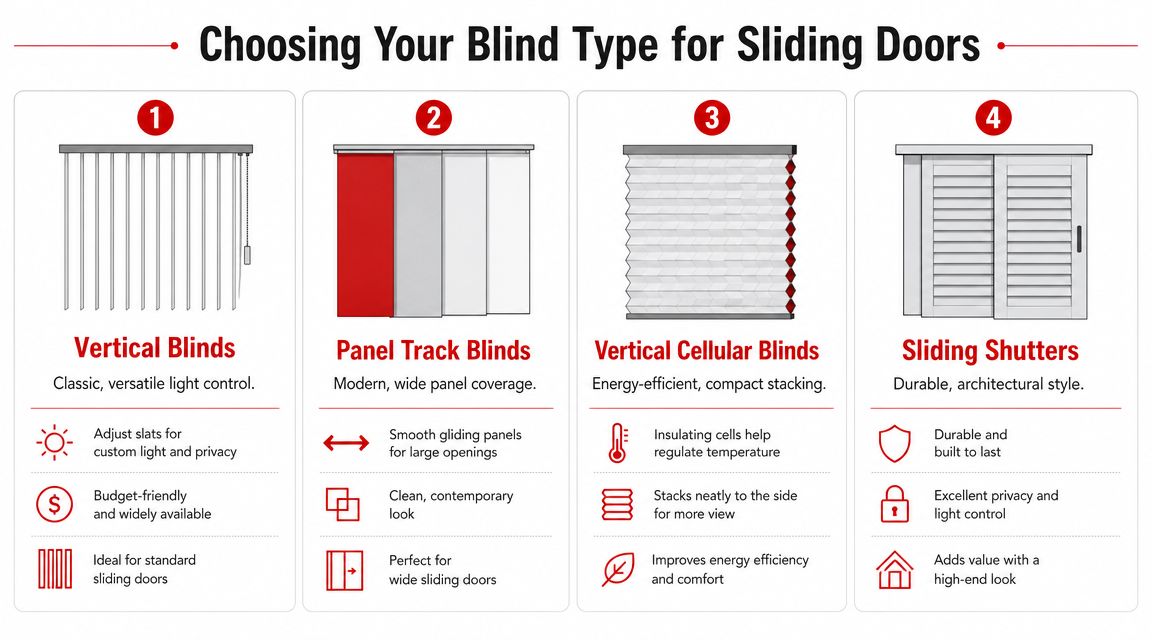
For most sliding doors, the safest place to start is with lateral operation. In UK practice, vertical blinds and panel-track styles are most often specified for sliding doors because they move in the same direction as the door. That avoids the obvious problem of lifting a wide, heavy blind every time the opening is used, which is why horizontal blinds are generally not recommended for sliding glass doors according to guidance on sliding door window treatments.
That basic design rule saves a lot of regret later.
The main options that actually suit a doorway
Vertical blinds remain the default for a reason. They suit wide spans, give flexible light control, and don't demand much force to move. If the door is used all day, a wand-operated vertical system is still one of the easiest formats to live with.
Panel track blinds do the same job with wider fabric panels. They look cleaner and more architectural, and they often stack more neatly than people expect. The trade-off is that stack-back can still eat into the clear opening, especially on smaller doors where every centimetre matters.
Vertical cellular blinds make sense where insulation is high on the list. They keep the side-to-side movement you want for a sliding door, but with a softer look and a more compact feel than some older vertical systems.
Sliding shutters can work, but only where there's enough room for the track, panel travel, and full handle clearance. They're less forgiving than blinds when the opening is tight or the frame isn't perfectly straightforward.
Roller blinds and ordinary pleated blinds can be fitted to some sliding doors, but they're usually a compromise. They move up and down, not side to side. On a frequently used door, that often becomes irritating very quickly.
Sliding Door Blind Options at a Glance
| Blind Type | Best For | Ease of Access | Stack Back | Light Control |
|---|---|---|---|---|
| Vertical blinds | Busy family doors, rentals, practical everyday use | Very good | Moderate | Very flexible |
| Panel track blinds | Modern interiors, wider openings | Good | Moderate to large, depending on panel width | Good, depends on fabric |
| Vertical cellular blinds | Thermal comfort, softer look | Good | Compact | Good |
| Sliding shutters | Architectural finish, durable fitted look | Good if space is planned well | Large compared with fabric systems | Very good |
Practical rule: If the door opens several times a day, choose a blind that can stay clear of the traffic path without needing to be lifted first.
What usually works best in real rooms
In a standard living room or kitchen-diner, vertical blinds still solve the most problems for the least fuss. In a newer extension with broad glazing and a cleaner interior scheme, panel tracks often make more visual sense. If heat loss and comfort matter more than a minimalist look, vertical cellular systems deserve a proper look rather than being treated as a niche option.
The door itself also influences the blind choice. If you're replacing the glazing and planning the full opening from scratch, browsing C & C Windows luxury patio doors is useful for seeing how frame proportions, panel layout, and handle positions affect what can be mounted successfully inside the room.
The mistake I see most often is choosing by swatch first and operation second. On sliding doors, that order should be reversed.
Key Factors for Selecting the Perfect Blind
A blind can look excellent in the showroom and still be wrong for the room. The decision gets easier when you judge it against four things that affect daily use: privacy, light, thermal performance, and wear.
Start with how the room behaves
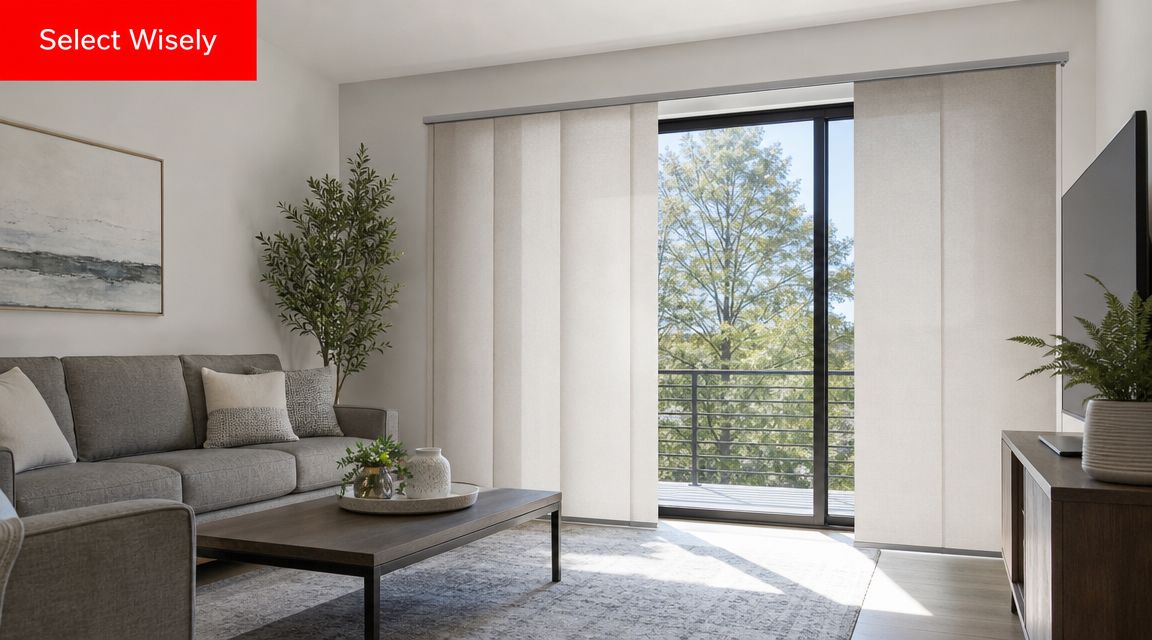
Ask what happens at the door at three points in the day. Morning sun, afternoon glare, and evening privacy often pull the blind choice in different directions. A south-facing opening may need better glare control, while a garden-facing sitting room may prioritise privacy after dark without making the room feel boxed in during the day.
Vertical vanes are useful here because they let you redirect light instead of merely blocking it. That matters more on a sliding door than on a small window because the glazed area is larger and the sun can spill much deeper into the room.
Use this quick filter before you choose:
- If privacy matters most: go for a denser fabric or less translucent panel.
- If the room feels gloomy: choose a material that filters light rather than trying to black it out.
- If the door is in constant use: prioritise smooth travel and simple controls over decorative detail.
- If the blind sits near cooking or pets: choose something that wipes clean and doesn't trap grime easily.
Don't treat thermal performance as an extra
Large glazed doors change room comfort more than many buyers expect. According to energy-efficient window covering guidance, about 30% of a home's heating energy is lost through windows. On a broad sliding door, that turns the blind into part of the room's thermal strategy, not just a finishing touch.
That doesn't mean every room needs the heaviest or thickest product available. It means the blind should fit properly, close cleanly, and suit the way the door is used. A well-fitted panel or cellular system can do more for comfort than a decorative option that leaves gaps and is left open because it's awkward to operate.
The best blind is the one people will actually use every day. Performance on paper means very little if the blind is always parked open because it gets in the way.
Balance budget with replacement risk
Budget matters, but so does the cost of getting irritated by the product and replacing it early. A low-cost blind in a busy opening can become expensive if the vanes twist, the track sticks, or the fabric edges get knocked about.
I'd rank priorities in this order for most buyers:
- Operation
- Fit around the handle and frame
- Cleaning and durability
- Appearance
- Price
That order changes slightly for formal reception rooms or infrequently used garden doors, but not by much. On sliding doors, practicality nearly always wins in the long run.
How to Measure and Prepare for Installation
Good blinds for sliding doors start with careful measuring. Not approximate measuring. Not “close enough”. If the headrail is wrong, or the stack-back steals too much opening, the blind will annoy you every day.
Measure the opening, then measure the obstacles
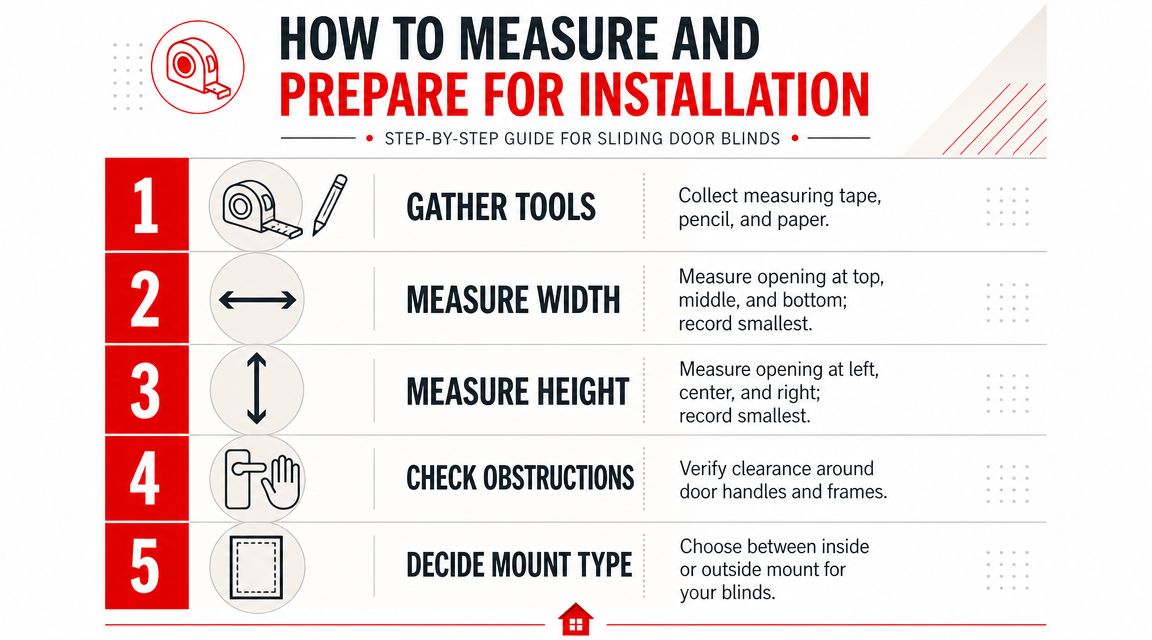
For a recess fit, measure the width at the top, middle, and bottom, then use the smallest figure. Measure the height at the left, centre, and right, then again use the smallest figure. That protects you against frames and reveals that aren't perfectly square.
For an exact fit outside the recess, measure the area you want to cover, not just the glass. Include enough coverage to reduce side gaps and to let the blind sit where the handle won't interfere.
Then check what is often overlooked:
- Door handles: project further than you think, especially on patio and lift-slide styles.
- Trickle vents or trim details: these can block the headrail or distort the drop.
- Skirting boards and radiators nearby: these affect how panels or vanes hang.
- Fly screen channels: if a screen is planned, you need room for both systems.
Recess fit or face fit
A recess fit looks tidy, but it only works if the reveal is deep enough for the blind and the handle. On many sliding doors, an outside or face fit is more forgiving because it lets the blind clear the hardware and gives better overlap for privacy.
This is also where stack-back matters. When the blind is open, where does it sit? If it stacks over fixed glass, that's usually fine. If it stacks over the traffic side of the opening, you may lose valuable access width.
Measure with the blind open in mind, not just closed. Closed position tells you coverage. Open position tells you whether the door still works well.
Match the product to the scale of the door
Made-to-measure systems exist for these larger openings for a reason. UK suppliers commonly offer custom vertical blinds for openings from 18 to 96 inches wide and 36 to 96 inches tall, which shows how these products are designed for patio-sized apertures rather than ordinary windows, as outlined in custom vertical blind sizing guidance.
The same guidance also notes that modern systems can include cordless or wand-controlled mechanisms, which is useful where safety and straightforward operation matter. On a sliding door, simple controls usually age better than fiddly ones.
Before ordering, sketch the doorway and mark the stack side, handle position, frame depth, and any planned screen. That rough drawing prevents a surprising number of expensive mistakes.
Integrating Blinds with Fly Screens and Door Access
Many otherwise decent projects often go wrong at this stage. The blind is chosen in isolation, the fly screen comes later, and suddenly the doorway is a compromise instead of a system.
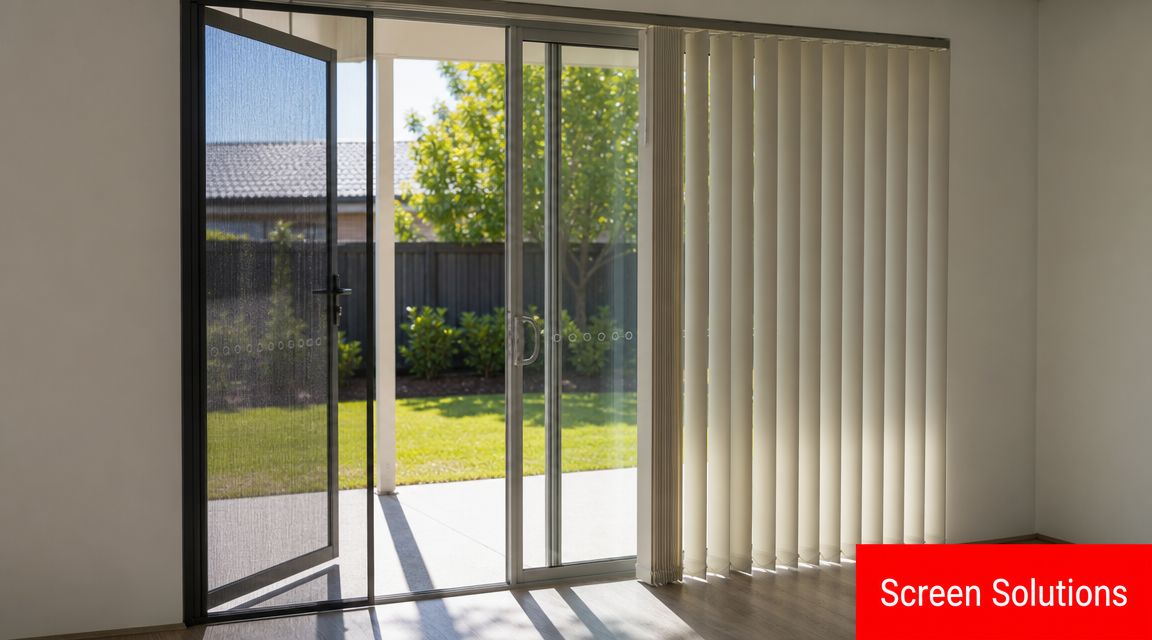
Why blinds and screens often clash
A standard inward-opening or hinged screen arrangement can compete directly with an internal blind. Both want swing room, fixing space, and clear access near the frame. Add a projecting handle and the problem gets worse.
That's why I advise people to stop thinking in separate product categories. If you want ventilation, privacy, and easy access, you're not buying only blinds for sliding doors. You're planning a doorway package.
The cleanest combinations usually involve a laterally operating blind inside and a retractable or sliding screen arrangement that sits within its own channel. That way, one system controls light and privacy, while the other handles insects and airflow without either one fouling the other.
Pairings that tend to work
Some pairings are easier to live with than others.
- Vertical blinds plus retractable screen: practical in busy family doors because both systems can clear the opening efficiently.
- Panel track blind plus slim framed screen: works well in contemporary spaces if the stack side is planned properly.
- Cellular sliding blind plus discreet screen: useful where comfort and ventilation both matter.
- Shutters plus screen: possible, but only if the frame depth and track arrangement are carefully planned from the start.
If the opening is used for carrying food outside, letting dogs in and out, or constant summer traffic, the access pattern matters more than the décor scheme. A beautiful blind that people brush past all day won't stay beautiful for long.
Plan the sightlines and movement path
Stand inside the room and decide three things before ordering anything:
- Which panel opens most often.
- Which side the blind should stack to.
- Whether the screen needs to retract from one side or split from the centre.
That sequence matters. It prevents the common mistake of fitting the blind so it always parks over the active door leaf or blocks the easiest route outside.
A made-to-measure fly screen supplier such as Premier Screens Ltd can be one option when you need a screen system built around a specific opening, because the range includes retractable and sliding solutions for doors as well as heavier-duty formats for more demanding access points. The key point isn't the brand. It's the planning. The blind, the screen, and the walking route need to work as one arrangement.
Beyond Aesthetics Safety Allergies and Ventilation
A sliding door treatment shouldn't create new problems while solving light and privacy. Safety, cleaning, and airflow deserve the same attention as colour and fabric.
Child and pet safety
On a doorway, control positions matter because people brush past them. That's one reason wand-operated vertical systems and cordless sliding formats make sense. They keep operation straightforward and reduce the clutter that can collect around a busy opening.
Pets create a different kind of stress. Tails, paws, and repeated nudging at the leading edge can punish a delicate blind. If animals use the door often, choose materials that recover well from contact and controls that don't hang into the route.
Allergies and indoor air quality
Ventilation helps, but open doors also let in pollen, insects, and outdoor debris. If someone in the home has hay fever, the sliding door can become the weak point in the room. A blind alone can't address that.
A better setup is often a blind for privacy and light control paired with a suitable mesh screen for ventilation. That lets fresh air move through the opening while reducing what comes in with it. It also means the blind doesn't need to stay closed only because you want the door open.
Good doorway planning gives you three things at once: privacy when you need it, airflow when you want it, and a route outside that still feels easy to use.
Think like a specifier, not just a shopper
The same mindset applies in more regulated settings. If you're comparing options for homes, care environments, or commercial buildings, it helps to look at adjacent categories too. For example, where compartmentation or higher protection standards come into play, this overview of types of fire-rated window shutters is useful for understanding how safety-led openings are specified differently from decorative ones.
That doesn't mean a sliding door blind needs to become an industrial product. It means you should judge it by the actual conditions around the opening. Who uses it, how often, and what else the opening needs to do.
Solutions for Commercial and High-Traffic Areas
A restaurant servery, care setting, shared terrace entrance, or staff breakout area doesn't behave like a quiet domestic patio door. Yet many buyers still start with residential blinds and only later discover the weak points.
Where standard domestic blinds fall short
The main issue isn't appearance. It's repeated contact, cleaning demand, and uninterrupted access. Existing advice often centres on what looks neat or classic, but it rarely deals with whether the doorway is used constantly, whether staff need hands-free movement, or whether the treatment can cope with strict hygiene routines. That gap is one reason guidance on vertical blind use in busy openings highlights the missed discussion around alternatives such as PVC strip curtains or heavy-duty screens where function matters more than appearance.
In these settings, the question changes from “Which blind suits the room?” to “What survives the way this opening is used?”
Better fits for busy access points
For high-traffic commercial environments, the answer is often not a traditional blind at all.
- PVC strip curtains: useful where people and trolleys need fast passage and the opening must stay operational.
- Chain fly screens: helpful where airflow matters and impact resistance is more important than a domestic finish.
- Heavy-duty screen doors: better where insect control and repeated use need a more sturdy assembly.
- Simple wipe-clean verticals in low-impact zones: acceptable in some reception or waiting areas, but usually not near the hardest-working openings.
Food preparation and hospitality spaces also need surfaces and components that can be cleaned easily. Fabrics that hold grease or hardware that catches dirt usually create maintenance issues sooner than expected.
Match the treatment to the job
For facilities teams, the practical checklist is short:
| Area type | Usually prioritise |
|---|---|
| Staff or service access | Hands-free movement and durability |
| Dining or customer-facing areas | Appearance plus controlled access |
| Care and education settings | Safety, easy cleaning, straightforward operation |
| Shared residential blocks | Durability and simple replacement parts |
A blind still has a place in some commercial schemes. It just shouldn't be the default answer when the doorway is part of a working route.
Installation and Long-Term Maintenance Tips
The easiest way to shorten the life of blinds for sliding doors is poor setup. The second easiest is ignoring the track and controls until something starts dragging.
Get the installation details right
Before fixing anything, confirm the stack side, bracket spacing, and the travel path of the blind in both open and closed positions. A sliding door treatment has to work dynamically. It's not enough for it to look centred when shut.
The most technically suitable systems for this application are vertical blinds or sliding panels because they operate laterally, which reduces lead-edge wear and snag points in frequently used openings, as noted in guidance comparing sliding door blind formats. That advantage only holds if the track is level and the blind clears the handle properly.
A good pre-installation check includes:
- Confirming the fixing surface: plasterboard alone may need the right anchors or a stronger fixing point.
- Checking the headrail length against the actual opening: especially if trims or reveals taper.
- Testing the door fully open and fully shut: catches and handles can surprise you.
- Running the blind by hand before finishing: resistance usually signals a bracket or alignment issue.
Look after the parts that actually wear
Maintenance is mostly simple if you do it little and often. Dust builds first on the headrail, carriers, and leading edges. If that's left alone, operation gets rougher and people start forcing the blind.
For ongoing care:
- Vertical PVC vanes: wipe with a soft damp cloth and dry them off.
- Fabric panels: vacuum gently with a brush attachment and spot clean carefully.
- Tracks and gliders: keep free of dust and grit so the carriers move smoothly.
- Wands and control parts: tighten or replace once they show play, rather than waiting for a full failure.
If vanes sit out of line, check whether one carrier has twisted. If the blind feels sticky, clean the track before assuming the mechanism has failed. Most day-to-day faults come from dirt, minor misalignment, or repeated contact damage near the active edge.
Done properly, a sliding door blind should feel easy every time it moves. If it needs tugging, lifting, or a workaround, something in the setup is wrong.
If you're planning blinds, fly screens, or a complete access solution for a patio, kitchen, commercial doorway, or busy family entrance, Premier Screens Ltd offers made-to-measure screen systems for UK homes and businesses, including retractable door screens, sliding options, chain screens, and PVC strip curtain doors. It's a practical place to start if you want the blind, the screen, and the access route to work together rather than compete for space.