
Warehouse Screening: A UK Guide to Compliance and ROI
A warm day, a busy shift, and the loading bay stays open longer than it should. Forklifts keep moving, staff need air, and nobody wants to turn a fast goods-in process into a bottleneck. But that open gap also invites flies, dust, debris, and in some sites, a compliance problem that can't be brushed off at audit time.
That's where warehouse screening earns its keep. In practice, this means physical barriers at doors, loading bays, internal openings, and access points that let a warehouse operate at speed without leaving the building exposed. It is not about candidate screening or personnel checks. It is about controlling what enters the space, while keeping movement practical.
In UK warehousing, that matters more than it used to. Warehousing now sits inside a much larger logistics network, and the UK Warehousing Association has described it as a critical national infrastructure function, with the Office for National Statistics showing sustained growth in logistics-related activity. As throughput rises, more facilities need warehouse designs that combine pest exclusion with airflow management to support food and workplace standards, as noted in this UK warehousing and safety context.
An Introduction to Warehouse Screening
Warehouse screening usually starts with a simple question. What are you trying to stop, and what still needs to move through the opening? If you don't answer both parts, you end up with a barrier that looks fine on installation day but causes daily friction once operations begin.
In most commercial sites, the pressure points are predictable. Goods-in doors stay open. Roller shutters create large exposed openings. Pedestrian exits get used more often than planned. Internal doorways between cleaner and dirtier zones become weak spots. The right screen has to deal with those realities, not an idealised version of them.
What warehouse screening covers
Physical warehouse screening generally includes:
- External door screening for loading doors, side doors, dispatch points, and staff access routes
- Internal segregation between storage, packing, and processing areas
- Barrier systems that reduce pest ingress while allowing ventilation
- Access control support where a site needs to manage movement as well as hygiene
That last point often gets missed. A screen is rarely just a pest-control item. In a busy building, it also affects traffic flow, visibility, cleaning routines, and how staff use the opening in real life.
Practical rule: If staff prop a screen open because it slows them down, the product choice was wrong even if the specification looked sensible on paper.
Why the issue has become more urgent
The old view was that screens were an add-on for summer months or a reactive fix after a pest issue. That's not how most well-run sites treat them now. Warehouses handle more movement, more mixed stock, and more pressure to keep operations controlled without restricting airflow.
That changes the buying decision. The cheapest barrier at the doorway may solve one problem and create three more. A proper warehouse screening decision looks at hygiene risk, wear rate, cleaning effort, traffic pattern, and replacement cycle together. That is where total cost of ownership matters far more than headline purchase price.
Why Warehouse Screening Is Non-Negotiable
A roller shutter is left open for ten minutes during a busy intake. Forklifts keep moving, warm air pulls insects and dust inside, and nobody on shift sees it as a problem because the work still gets done. Later, the site is dealing with extra cleaning, rejected stock checks, and awkward questions during an audit. That is usually how screening failures show up. Not as one dramatic incident, but as repeated small losses that cost time and money.
For UK operators handling food, ingredients, or packaging near food processes, screening is a requirement of basic hygiene control. The Food Standards Agency expects premises to reduce contamination risk and protect openings where insect ingress is a realistic hazard. In practice, that means a warehouse cannot rely on staff intention alone. If a doorway needs to stay usable for traffic and ventilation, it also needs a physical barrier that stands up to daily use.
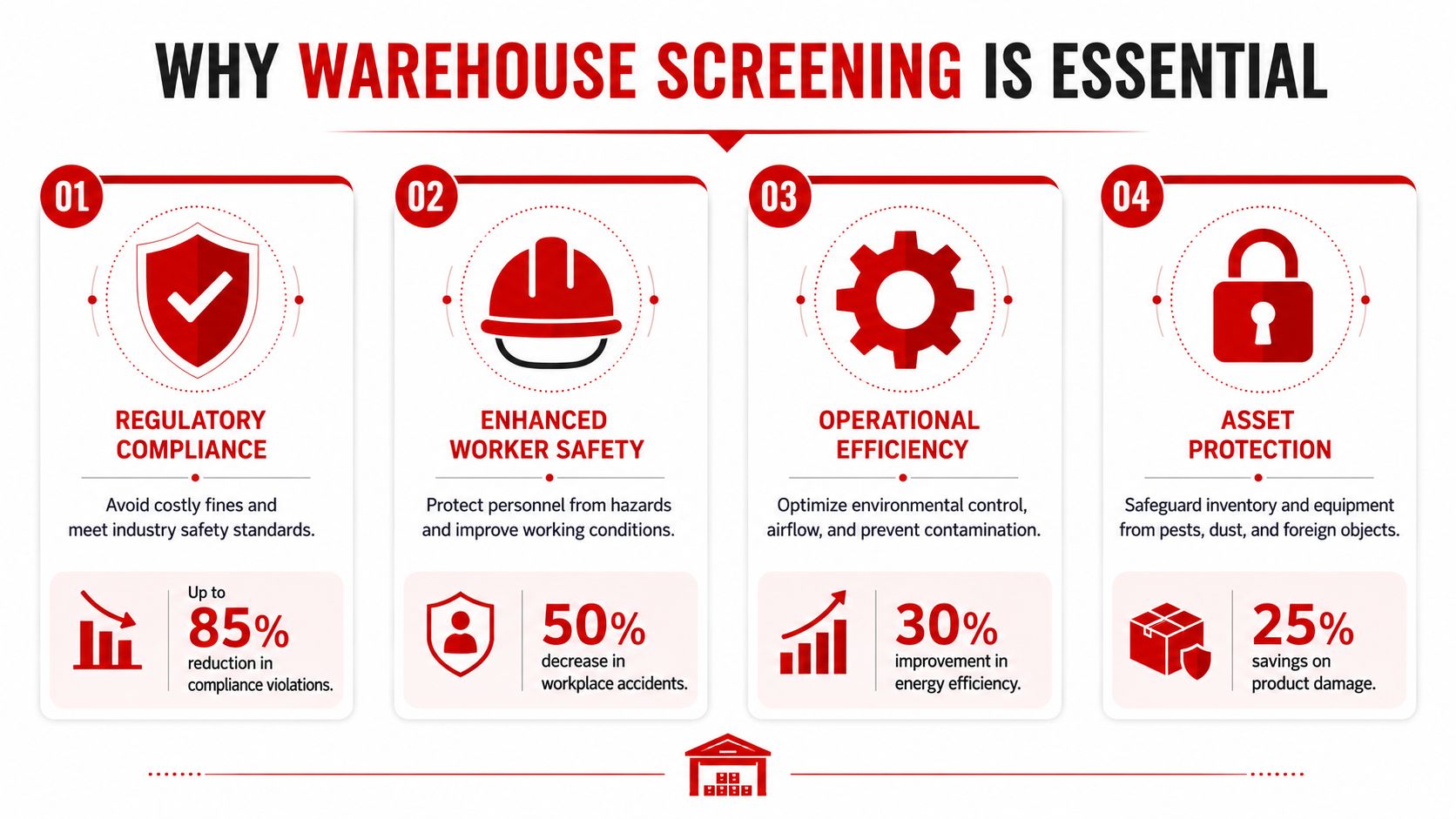
Compliance sets the minimum standard
Inspectors and auditors look at whether controls are built into the site, maintained, and suited to the risk at each opening. A food storage doorway, a dispatch exit, and a staff entrance do not need identical barriers, but they do need a documented reason for the choice. That matters under UK hygiene rules, and it matters for insurance, customer audits, and due diligence if an incident has to be investigated.
I often see sites rely on habits instead of design. Doors are meant to stay closed. Staff are meant to report pest activity. Cleaning teams are meant to catch contamination early. Those controls help, but they weaken fast when the building gives pests and debris an easy route in.
The business case is usually stronger than the compliance case
The purchase price of a screen is the smallest number in the decision. The bigger costs sit in the years that follow.
A barrier that cuts pest ingress but slows a busy doorway can be bypassed within a week. A cheaper product that tears, drags, or traps dirt will cost more in replacement labour, cleaning time, and stock risk than a better-specified system fitted once. That is why total cost of ownership matters more than the invoice value.
The practical gains are straightforward:
- Lower contamination risk: Fewer insects, less airborne debris, and less avoidable exposure at open thresholds
- Less waste and rework: Stock does not need the same level of checking after every period of open-door activity
- Better airflow control: Sites can keep ventilation where needed without giving up basic protection
- More consistent operating discipline: A proper barrier makes the intended route and level of control obvious
- Lower lifetime cost: The right screen lasts longer and gets bypassed less often, which protects the original investment
For operators reviewing broader site hygiene, guides on protecting your industrial facility can be useful because they place screening within a wider prevention plan rather than treating it as a one-off purchase.
A screen should reduce risk without creating a new operational problem. If staff avoid using it, the site has paid for a barrier that exists only on paper.
Where warehouses lose money
The usual failure is choosing by appearance or unit price instead of traffic pattern. A tidy-looking barrier can still be the wrong answer if pallet trucks catch it, if pickers push through it all shift, or if the cleaning team cannot wash it properly.
Another common mistake is over-specifying low-risk doors and under-specifying high-use ones. A pedestrian side door may suit a lighter option, including chain fly screens for commercial doorways, while a food-adjacent opening with frequent trolley or forklift movement needs something built for repeated contact and stricter hygiene control. One type does not cover every doorway well.
Good screening decisions come down to trade-offs. Airflow versus exclusion. Access speed versus containment. Lower upfront spend versus longer service life. Sites that manage those trade-offs judiciously usually spend less over time and have fewer compliance headaches.
Choosing Your Warehouse Screening Solution
The right warehouse screening solution depends less on catalogue features and more on traffic type, opening size, cleaning regime, and risk tolerance. I'd separate decisions into four broad categories: strip curtains, chain screens, framed heavy-duty screen doors, and retractable systems. Each has a place. Each also has limits.
For mixed-use UK sites, screening isn't only about hygiene. It also helps manage who and what moves through the building, balancing security, airflow, and fast movement at entrances and separation points in facilities handling controlled goods, as discussed in this mixed-use warehouse access and security context.
Warehouse screening solution comparison
| Screen Type | Best For | Pest Control | Airflow | Durability & Access |
|---|---|---|---|---|
| PVC strip curtains | Forklift routes, loading bay transitions, internal traffic lanes | Good when strips overlap correctly and remain in condition | Moderate to good | Strong for repeated pass-through, but wear builds at contact points |
| Chain screens | Pedestrian doorways, lower-risk access points, warm-weather ventilation | Moderate, depends on gap control and site conditions | Very good | Simple access, lower resistance, less suited to stricter hygiene zones |
| Heavy-duty aluminium screen doors with metal mesh | Food-adjacent openings, controlled access points, mixed-use sites | Strong when fitted tightly and maintained well | Good | High durability, more structured access, supports segregation |
| Retractable screens | Openings used intermittently, spaces needing flexible use | Good for the right opening | Good | Useful where a permanent barrier would obstruct operations, but needs careful handling |
Match the barrier to the movement
A loading bay with constant pallet traffic needs forgiveness. PVC strip curtains work because they allow repeated movement without forcing operators to stop and open a leaf door every time. They're practical, but only if strip width, overlap, and mounting height are right. If the strips are too light, too short, or badly aligned, they stop acting like a barrier and become decoration.
Pedestrian-only side doors are different. For these, Chain fly screens can make sense. They preserve airflow well and don't create much friction for staff walking through with small items. They are not the answer for every hygiene-critical doorway, but for the right opening they're straightforward and easy to live with.
When framed screen doors justify the extra spend
If the doorway separates a more controlled area from general warehouse activity, a framed system often pays back through consistency. A well-built screen door gives you clearer closure, a more defined threshold, and fewer bad habits than a loose hanging barrier.
That matters in mixed-use sites where the opening also has a security function. A barrier that merely hangs in place won't do much to control unauthorised movement. A framed option can support that need while still allowing airflow. One example of this category is heavy-duty insect screen doors for commercial openings, which sit in the middle ground between simple ventilation screening and more controlled physical separation.
Retractable systems and flexible openings
Retractable screens suit openings that are not in permanent use, or where the barrier would get damaged if left exposed all day. They are most useful where managers want screening available when needed, but not occupying the opening during unloading, maintenance, or seasonal changes.
They are less forgiving in high-impact forklift routes. If an opening takes regular knocks, a retractable product usually becomes an expensive lesson unless the use pattern is tightly controlled.
Buy for the opening's worst day, not its average day. If peak shift traffic would destroy the screen, the quieter days don't matter.
Don't ignore the surrounding environment
The barrier itself isn't the full answer. Moisture, temperature swings, and air movement affect how well a screen performs and how long it lasts. In storage environments and container-linked operations, attention to ventilation strategy also helps manage container condensation, especially where stock condition is sensitive to damp or trapped air.
A final point on selection. Premier Screens Ltd is one UK manufacturer supplying bespoke commercial screening options across categories including heavy-duty doors, chain screens, and PVC strip systems. That kind of made-to-measure approach matters in warehouses because standard sizes rarely deal well with uneven openings, threshold details, or existing steelwork.
Selecting The Right Mesh and Material
The frame gets most of the attention, but the mesh or barrier material usually determines whether the screen performs properly after installation. “Mesh” sounds simple until you have to specify it for a food-adjacent doorway, a midge-prone location, or a rough traffic area where trolleys clip the opening all week.
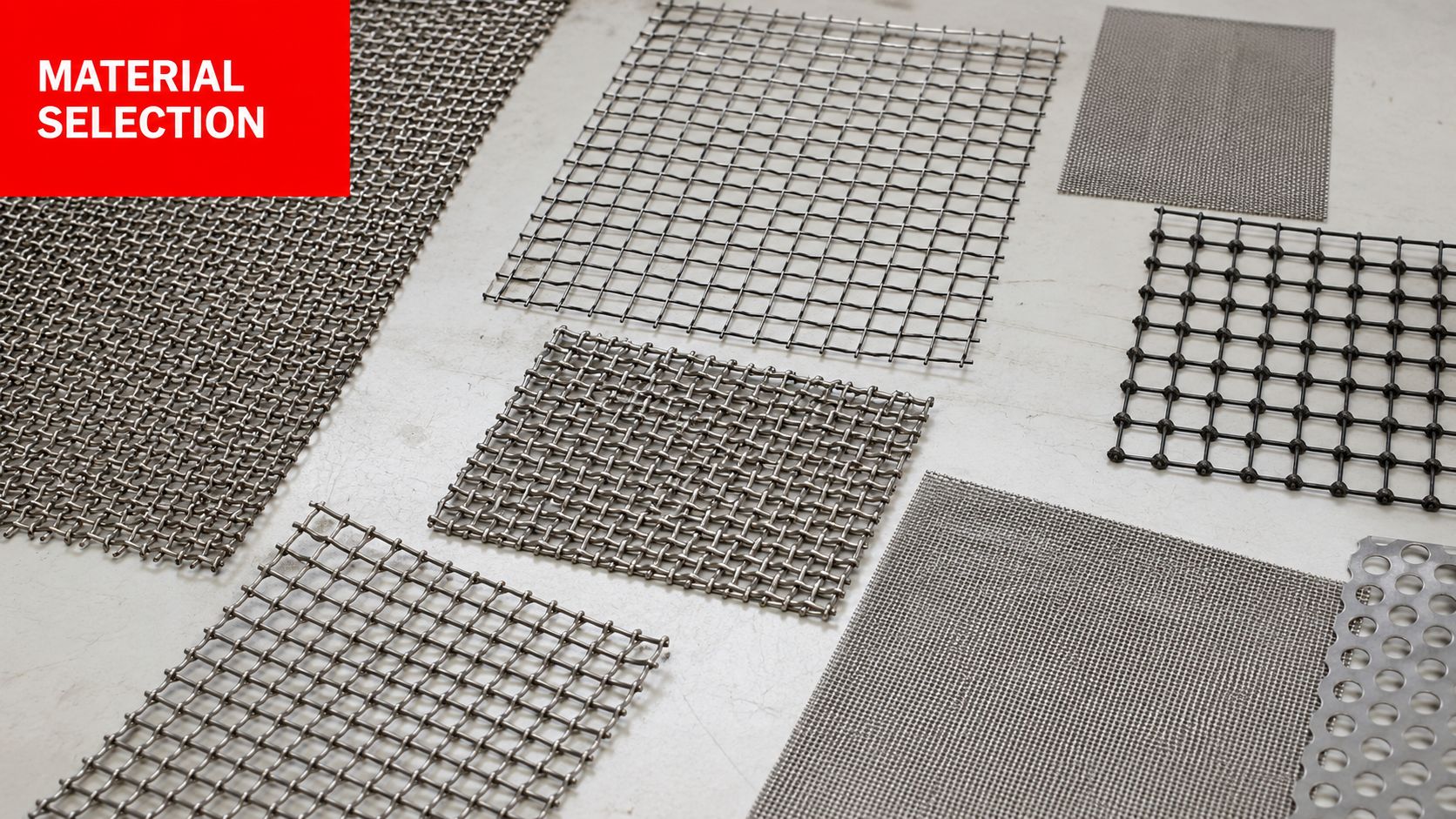
Match mesh size to the actual pest problem
A standard insect mesh is often enough for general fly control. It allows good airflow and covers the common warehouse problem of larger flying insects entering through open side doors and service entrances.
Finer mesh changes the equation. It can help where smaller insects are the issue, but the trade-off is increased resistance to airflow and, in some environments, faster visible dirt loading. If a site asks for the finest mesh available without checking the ventilation consequence, they often create a comfort problem that staff try to solve by keeping doors open longer.
Material choice matters in food environments
Food-related sites should think carefully about cleanability, corrosion resistance, and how the material copes with washdown or damp conditions. In practice, stainless steel mesh often becomes the sensible choice where hygiene standards are stricter, because it is durable, non-corrosive in the right setting, and easier to clean thoroughly than softer or more fragile alternatives.
That doesn't mean every warehouse door needs stainless steel. It means the material should reflect the zone. A goods-in area feeding a packing line has different expectations from a general merchandise dispatch entrance.
Use wear resistance where the opening takes abuse
Some openings fail because the mesh doesn't suit the traffic. Repeated contact from cages, pallets, box corners, or cleaning equipment can destroy a lighter screen long before the frame gives up. In those areas, a tougher mesh or a completely different barrier type may be more economical over time.
A simple way to specify the right combination is to ask three questions:
- What has to be excluded: Flies, smaller insects, dust, or casual access
- How is the opening used: Pedestrian only, trolley traffic, or equipment movement
- How is the area cleaned: Dry wipe, washdown, or frequent hose-down
The right specification is rarely “the strongest mesh”. It's the mesh that survives the cleaning routine, supports the airflow target, and still controls the risk you actually have.
If you skip that thinking, you often pay twice. First for the wrong material, then again for replacement and disruption.
Balancing Ventilation Airflow and Protection
Most objections to warehouse screening come down to one concern. Will this make the building hotter, stuffier, or harder to work in? That concern is valid. If ventilation drops too far, staff notice it immediately, and operations managers hear about it before the month is out.
The answer isn't to avoid screening. It's to choose a barrier that fits the airflow requirement of the opening.
Different barriers affect air movement differently
Chain systems obstruct airflow very little, which is why they're often useful on lower-risk pedestrian openings. Standard mesh screens preserve airflow reasonably well while still creating a defined barrier. Finer mesh restricts it more. Strip curtains don't function like open mesh at all, but they can still support practical air exchange while controlling movement through larger openings.
That's why blanket rules fail. “Mesh is best” or “strips are best” tells you nothing unless you also know what the warehouse is trying to ventilate.
Assess the room before you assess the product
Look at the operating conditions around the doorway:
- Heat sources: Chargers, machinery, compressors, and sun-facing walls all affect air demand.
- Occupancy pattern: Shift changes and peak picking periods can change comfort quickly.
- Opening behaviour: A door opened constantly behaves very differently from one opened every half hour.
- Environmental target: A temperature-controlled zone may need a stricter barrier than a general storage space.
If a doorway is the main route for passive ventilation, don't choose the highest-resistance screen by default. If the room already has mechanical ventilation and the opening mainly needs pest control, you can specify a tighter barrier without creating the same discomfort.
Practical ways to improve the balance
Good results usually come from combining measures rather than asking the screen to do everything.
- Reduce unnecessary open time: Door discipline and sensible routing still matter.
- Choose barrier by zone: One site can use strips at a loading route, framed mesh at a staff door, and chain screening at a lower-risk entrance.
- Keep screens clean and aligned: Dirt loading, damage, and gaps hurt both airflow and protection.
- Review the doorway surround: Poor seals at sides and thresholds waste the value of the barrier.
A warehouse doesn't need perfect isolation. It needs a workable balance where staff can move, air can circulate, and the opening isn't effectively unprotected.
Installation and Maintenance For Longevity
A good screen installed badly becomes a maintenance issue from day one. Most failures I see are not dramatic product failures. They are poor measurement, weak fixing into the wrong substrate, gaps around uneven openings, or neglect after installation.
The basics matter. Measure the structural opening, not the idealised drawing. Check whether the frame is square. Note floor falls, damaged lintels, rails, pipes, and anything that interferes with full closure. If the opening serves forklifts, confirm the actual clearance needed, not the nominal width on plan.
Installation points that protect your investment
A proper installation routine should cover:
- Seal quality: Side gaps, threshold gaps, and distorted corners are where performance is lost first.
- Fixing method: Match anchors and fixings to steel, blockwork, cladding support, or timber. Don't improvise on site.
- Swing and clearance: Doors need room to operate without hitting pallets, guards, or parked equipment.
- User behaviour: If staff need to force the barrier, lift it awkwardly, or detour around it, wear will increase fast.
For higher-traffic openings using flexible barriers, products such as perforated PVC strip curtains can be useful where airflow and repeated pass-through both matter, but only if the strips are cut and mounted for the specific opening.
Maintenance that actually extends service life
Maintenance does not need to be complicated. It needs to be consistent.
- Inspect weekly in busy periods. Look for torn mesh, bent frames, missing fixings, chain tangles, split strip edges, and daylight at the perimeter.
- Clean with the material in mind. Abrasive cleaning shortens the life of mesh, coatings, and clear strips. Use methods that remove dirt without scratching or clouding the surface.
- Check closure behaviour. Hinged and retractable systems usually show problems first in misalignment and poor return. Fix those early.
- Replace components before failure spreads. One damaged strip or a loose edge can lead staff to bypass the whole barrier.
Maintenance should follow traffic, not the calendar. A doorway used all day needs more attention than a perfect-looking screen in an opening nobody uses.
Where ROI is won or lost
Total cost of ownership sits in the small details. A bespoke fit that seals properly often costs more upfront and less over time. A cheaper screen that needs constant adjustment, creates cleaning headaches, or gets replaced after minor impacts rarely stays cheap for long.
The screen should be treated like any other working warehouse asset. It needs a named owner, a simple inspection list, and a replacement plan for wear parts.
Calculating ROI and Making The Right Investment
The cleanest way to think about warehouse screening ROI is this. What does the barrier prevent, and what does it allow you to keep doing efficiently? If it reduces contamination risk, supports compliance, and keeps airflow usable without slowing the operation, it is doing revenue-protection work as well as hygiene work.
Two examples show how the maths changes by site type.
A food packing warehouse usually values tighter control over an opening, easier cleaning, and clearer segregation between zones. In that case, a heavier-duty framed solution with the right mesh may justify the higher upfront cost because failures carry bigger hygiene consequences.
A general logistics hub with heavy pallet traffic may get better value from strip curtains on main vehicle routes and lighter screening on side access doors. The priority there is often keeping throughput smooth while reducing ingress at the most exposed points.
Use a short decision test:
- What is the cost of a compromised opening?
- How often is the opening used?
- What maintenance burden can the team realistically manage?
- Will staff use the barrier properly during peak pressure?
The right investment is rarely the cheapest product and rarely the most capable one everywhere. It is the one that fits the operational reality of each opening.
If you're reviewing warehouse screening across one site or several, Premier Screens Ltd is a UK option for bespoke fly screens and commercial door screening systems, including heavy-duty doors, chain screens, and PVC strip solutions. For facilities teams, the practical advantage is being able to specify made-to-measure barriers around the opening, traffic pattern, and hygiene requirement rather than forcing a standard product into a non-standard warehouse.