
Retractable Fly Screens for Patio Doors: A Buyer’s Guide
You open the patio doors for an hour of evening air. The kitchen cools down, the room feels lighter, and then the flies find the opening before you've even sat down. That's the point where many homeowners start looking for a screen that works without turning a good-looking doorway into a permanent barrier.
In the UK, that problem shows up in all sorts of homes. It's a new-build with bifolds facing the garden. It's a narrow uPVC slider at the back of a 1990s extension. It's an older timber opening that looks square until you put a tape measure on it. The right screen can solve the insect issue cleanly. The wrong one can rattle, drag, leave gaps, or spoil the doorway you paid for.
Reclaiming Your Patio With a Modern Fly Screen
A lot of enquiries start the same way. Someone wants to keep the patio door open in warm weather, but they're tired of choosing between airflow and insects. In homes, that usually means flies around food, midges in the evening, and the constant opening and closing of doors that were meant to stay open. In cafés, staff rooms, garden-facing lounges, and managed properties, it becomes a comfort and maintenance issue as well.
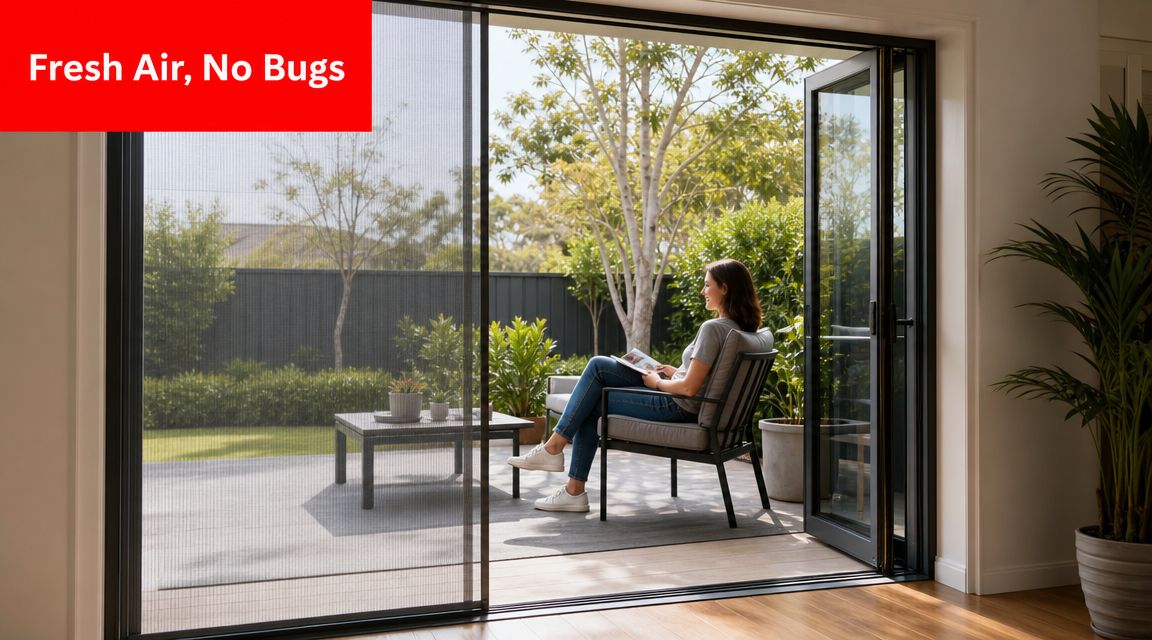
Retractable fly screens for patio doors solve that neatly because the screen is there when you need it and out of sight when you don't. That matters on a patio opening more than almost anywhere else. People choose patio doors for light, views, and easy access to the garden. A fixed barrier often undermines all three.
This isn't a fringe product category either. The global retractable screen door market was valued at $8,541.64 million in 2021 and was forecast to reach $10,382.4 million by the end of 2025, with the residential segment identified as the dominant application, according to Cognitive Market Research's retractable screen door market report. That tells you these systems are well established in the kinds of homes where open-door living matters most.
If mosquitoes are part of your problem rather than an occasional nuisance, it's also worth understanding local pest pressure before you choose any screening or treatment approach. For practical guidance on that side of the issue, see Crown Point's top mosquito experts.
What good looks like
A good retractable screen should do four things well:
- Disappear neatly: it shouldn't dominate the doorway when parked.
- Move smoothly: opening and closing should feel controlled, not flimsy.
- Seal properly: gaps at the sides, top, or threshold defeat the point.
- Suit the opening: the best arrangement depends on whether you have sliding, French, or bifold doors.
For a visual sense of how these systems sit within real openings, the retractable screen door gallery is useful because it shows the difference between a screen that belongs to the doorway and one that looks added on as an afterthought.
A patio screen only earns its place if you still enjoy using the door every day.
How Retractable Fly Screen Systems Work
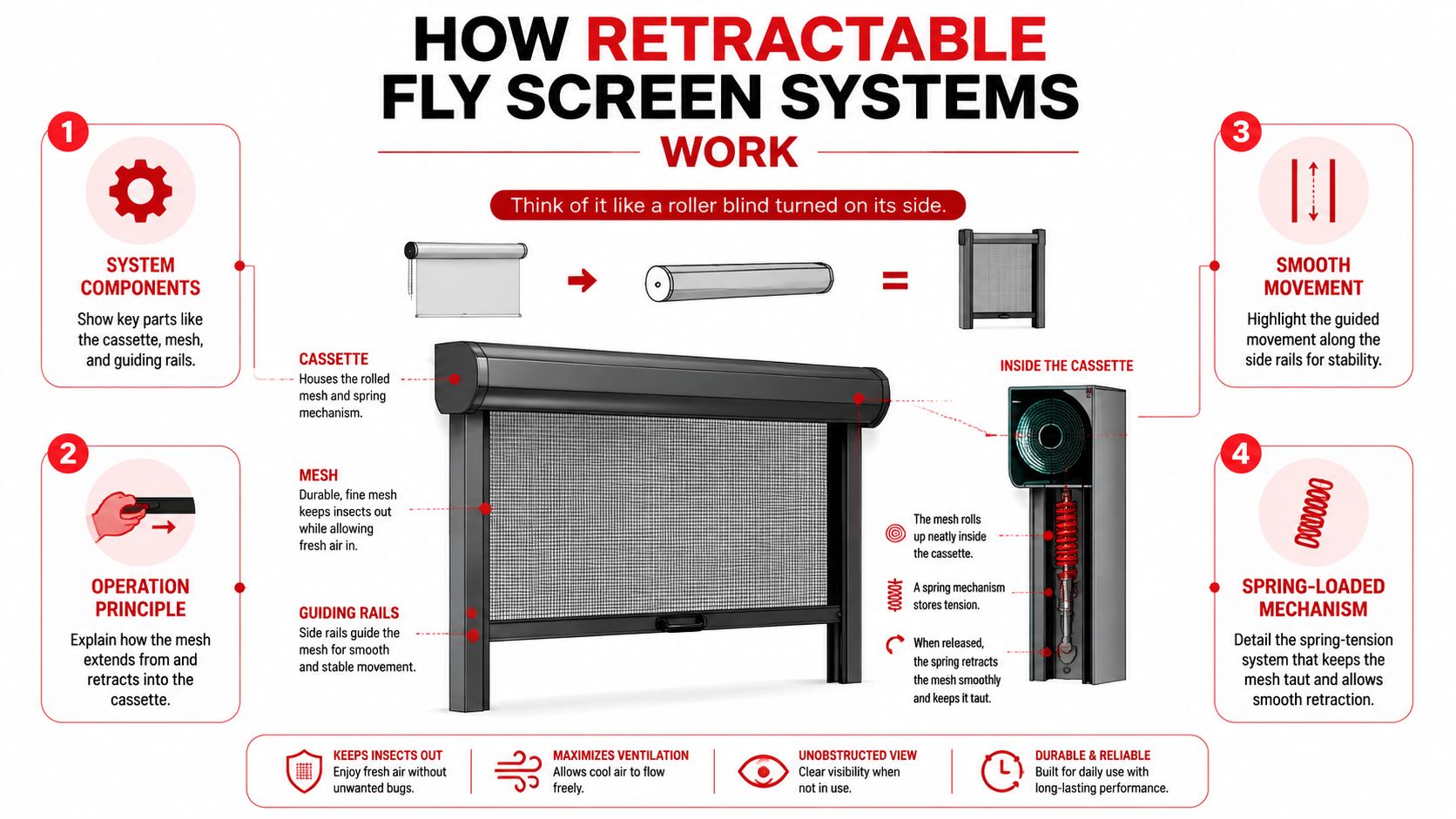
A clearer understanding of the product emerges when it's considered not as a traditional screen door, but as a roller blind turned sideways. The principle is simple. The mesh is stored in a slim side cassette, pulled across the opening when needed, and guided so it stays controlled from one end of travel to the other.
By 2015, manufacturers were already offering a broad range of screening solutions for windows and doors, including retractable formats, and modern systems were designed to disappear into slim housings when not in use, preserving light and views. That progression from basic fixed screens to retractable, pleated, and sliding options is outlined in this history of fly screens. In practical UK terms, that “disappearing” quality is one of the main reasons homeowners choose them for patio doors rather than fixed panels or hanging mesh curtains.
The parts that matter
A retractable system is only a handful of components, but each one affects performance.
- Cassette housing: this is the side unit that holds the rolled mesh. A slim, well-made cassette keeps the screen protected when not in use.
- Mesh panel: this is the working barrier. It needs to stay taut enough to move cleanly and resist sagging in normal use.
- Guide rails: these keep the screen travelling in line instead of wandering or bowing.
- Closing edge and latch arrangement: the point where the screen meets the far side of the opening and completes the seal.
- Tension mechanism: the spring or control system manages retraction and helps the mesh return without whipping back.
Why some systems feel better than others
The difference between a screen that feels precise and one that feels awkward usually comes down to alignment and tension. If the cassette is square, the rails are true, and the screen is built to the opening, movement stays smooth. If the opening is uneven or the fitting allowance is wrong, the user notices drag, poor closure, or visible light gaps very quickly.
That's why Retractable insect screen doors are better understood as engineered door products rather than simple accessories. On a patio opening, the screen is spanning a route people use constantly. It has to retract cleanly, sit discreetly, and hold its line every time.
Practical rule: if a retractable screen needs force to open or close on day one, something is wrong in the specification or fitting.
What doesn't work well
Three options usually disappoint on patio doors:
- Loose magnetic mesh curtains that flap, detach, or leave gaps around the edges.
- Generic cut-to-fit kits on non-standard openings.
- Fixed panels on doors you use as a main route to the garden.
They can all block insects to a degree, but they don't give the same balance of access, appearance, and day-to-day usability.
Matching a Screen to Your Patio Door Type
The right screen layout depends first on the door style. People often start by asking about mesh type or colour, but the bigger decision is how the screen should travel across the opening without getting in the way of normal use.
Retractable systems for large patio openings can be engineered to span up to about 15 feet wide by 12 feet high, while UK-style made-to-measure door systems commonly target apertures around 2.9 m by 2.4 m. The engineering challenge is maintaining mesh tension and edge seal over the travel length so the screen doesn't sag, flutter, or leave bypass gaps. That's discussed in this explanation of how retractable fly screens work.
Sliding patio doors
Sliding patio doors usually suit a single retracting screen best. The screen parks to one side when not in use and draws across the active opening when the glass door is open.
This arrangement works well because the door itself already has a directional logic. People expect movement left to right or right to left, and the screen follows the same pattern. It's neat, intuitive, and normally the least visually busy option.
Best fit for:
- Everyday family access where one panel is used most often
- Narrower rear openings where a double-screen arrangement would feel unnecessary
- Retrofit work where minimal visual change matters
French doors
French doors are different because traffic often flows through the centre. In that case, a pair of retractable screens meeting in the middle usually makes more sense than one oversized screen travelling the full width.
The reason is straightforward. A centre opening feels natural on double doors, and two shorter spans tend to behave better than one long unsupported sweep. If you're looking at centre-opening layouts, retractable insect screens for double doors show the kind of configuration that suits this style.
Bifold doors
Bifolds need the most care. The opening is wider, foot traffic is often heavier, and the threshold detail matters much more. A screen for bifolds must cope with span without becoming awkward to use.
When specifying for bifolds, focus on these points:
- Track profile: a bulky bottom rail becomes annoying very quickly on a busy opening.
- Mesh control: wide spans need proper tensioning or the screen will look tired early.
- Parking position: the cassette should sit where stacked bifold panels and handles won't clash with it.
- Usage pattern: if only one leaf is used regularly, the screen should support that reality rather than the fully open width on paper.
For wide garden openings, the best specification is often the one that serves the most common day-to-day opening, not the maximum possible opening.
Choosing the Right Mesh and Frame Materials
Once the layout is settled, material choice decides how the screen behaves in real life. It is at this stage that many buyers either over-specify and pay for features they don't need, or under-specify and end up with a screen that doesn't suit the household.
Mesh first, not frame colour
Questions about frame finish are often raised early because it's visible. In practice, mesh choice affects the result more. It changes airflow feel, visibility, durability, and how well the screen deals with your actual problem, whether that's general insects, tiny biting midges, pets, or seasonal pollen.
Here's a practical comparison.
| Mesh Type | Best For | Key Feature |
|---|---|---|
| Standard insect mesh | General household insect control | Balanced visibility and airflow |
| Fine midge mesh | Areas with very small insects | Tighter weave for smaller pests |
| Pet mesh | Homes with dogs or cats | Tougher resistance to scratching and impact |
| Pollen mesh | Allergy-conscious households | Helps reduce airborne pollen entering through the opening |
If pets are part of the decision, insect pet mesh is worth considering because a normal insect mesh can be damaged by repeated clawing or pushing at the lower section of the screen.
Real trade-offs between mesh types
There isn't a universal “best” mesh. There's only the right compromise for the opening and the people using it.
- Standard mesh: usually the right starting point for most patio doors. It keeps the specification simple and the view comfortable.
- Fine midge mesh: useful where tiny insects are the main annoyance, especially in the evening. The trade-off is that a finer weave can feel denser.
- Pet mesh: stronger, but strength comes with a different look and feel. It's sensible when the alternative is regular repair.
- Pollen mesh: appropriate when the household wants to ventilate more but is also trying to reduce allergen ingress.
For commercial sites, the brief changes. Durability, cleanability, and compliance tend to take priority over the least visible mesh. A facilities manager usually needs a screen that can cope with repeated use, routine cleaning, and staff traffic without becoming a maintenance issue.
Frame materials and finishes
For patio doors, powder-coated aluminium is usually the practical choice. It resists rust, holds shape well, and can be finished to sit comfortably against uPVC, timber, or aluminium doors.
Frame choice should answer three questions:
- Will it stay straight and stable in the opening?
- Will it tolerate weather, cleaning, and regular handling?
- Will it look like part of the doorway rather than a bolt-on extra?
A good frame doesn't need to draw attention to itself. On most jobs, the best compliment is that visitors don't notice the housing until the screen is in use.
Measuring and Fitting for a Perfect Result
The biggest mistake in this product category is assuming every patio opening is square, consistent, and easy to work with. In UK housing, that is not true. Older homes, later extensions, replacement frames, and mixed materials often produce openings that vary from top to bottom or lean subtly out of line.
That matters because a retractable screen relies on alignment. If the opening is out, the mesh won't forgive it. It may still fit physically, but it won't necessarily operate well or seal cleanly.
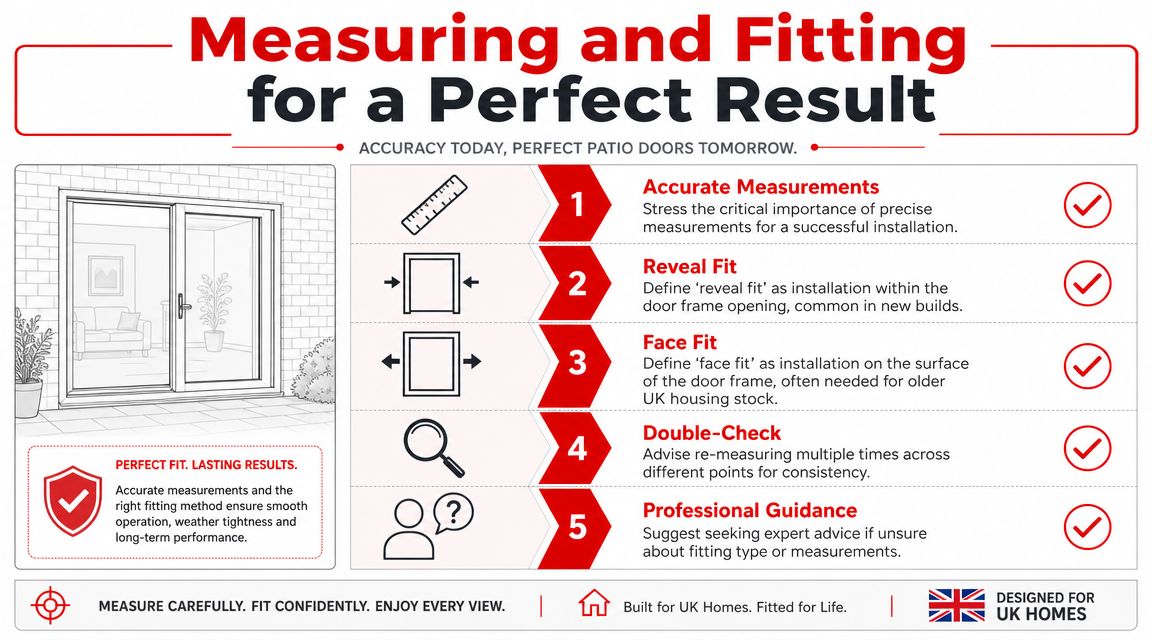
England's housing stock is among the oldest in Europe, and many homes have non-standard or out-of-square openings, which is one reason off-the-shelf screen solutions often fail on older uPVC, timber, or crittall-style patio doors. That point is captured well in this discussion of older housing stock and non-standard openings.
Reveal fit or face fit
These two fitting approaches solve different problems.
- Reveal fit: the screen sits within the opening or recess. This is often the cleanest look where there's enough depth and the sides are reasonably true.
- Face fit: the screen fixes onto the surrounding frame or wall face. This is often the safer choice where the reveal is shallow, uneven, obstructed, or not square enough for a neat internal fit.
On newer openings, reveal fit is often straightforward. On older properties, face fit frequently gives more room to create a proper seal and avoid clashing with handles, trims, or threshold details.
How to take useful initial measurements
Even if you plan to order a made-to-measure screen, it helps to understand the opening before speaking to a manufacturer. Use a metal tape, measure carefully, and record each figure.
Take:
- Width at the top, middle, and bottom
- Height on the left, centre, and right
- Depth of reveal or fixing area
- Handle projections and any trickle vents, cills, or trims
- Threshold detail, especially if you want the lowest possible trip profile
If the numbers vary, that's not unusual. It's the point of measuring in several places. The variation tells you whether the opening is square enough for a simple fit or whether the specification needs to account for irregularities.
If top, middle, and bottom don't agree, order to the opening, not to your assumption about it.
Where DIY measuring goes wrong
Most measuring errors happen in one of three ways:
- Only one width and one height are taken
- Obstructions are ignored, especially handles and trims
- The fixing surface is assumed to be flat when it isn't
That's why made-to-measure matters so much on UK homes. A retractable screen isn't difficult to understand, but it is unforgiving of casual measuring. The better the survey, the better the result.
Simple Maintenance for Long-Term Performance
A retractable patio screen doesn't need constant attention, but it does need basic care. Most service issues come from dirt in the tracks, debris around the threshold, or mesh that hasn't been cleaned for a long time. None of those are major problems if you stay ahead of them.
The maintenance routine that actually helps
For most homes, a simple routine is enough:
- Vacuum the guide tracks: use a brush attachment to remove dust, dead insects, and grit.
- Wipe the mesh gently: a soft cloth or soft brush keeps visibility clear without stressing the fabric.
- Check the cassette area: debris around the housing can affect smooth retraction.
- Inspect the closing edge: if it isn't meeting cleanly, look for dirt or a minor alignment issue first.
- Keep the threshold clear: patio openings collect leaves, crumbs, and garden debris quickly.
A clean screen works better as part of a passive ventilation approach. This guidance on retractable screens and ventilation notes that effective passive ventilation is an important overheating strategy during increasingly frequent hot spells, and a clean, well-maintained retractable screen allows significant airflow when patio doors are open while keeping pests out.
Common issues and the likely cause
Slow or uneven movement usually points to one of these:
- Dirty tracks
- Debris at the bottom rail area
- Misalignment from poor fitting or building movement
- Mesh damage from impact or pet wear
If the screen has suddenly started dragging, clean first and inspect second. If it has never moved correctly, the issue is more likely to be specification or installation rather than maintenance.
A retractable screen should feel light and controlled. If it starts feeling heavy, check for dirt before assuming a part has failed.
Commercial sites need a cleaning schedule
For food preparation and hospitality settings, maintenance should be part of routine hygiene checks rather than an occasional job. Staff need to keep tracks clean, check that the mesh remains intact, and make sure the screen closes properly after repeated use. A damaged or poorly closing screen doesn't just look neglected. It weakens insect control at the doorway where traffic is highest.
Common Questions About Patio Door Fly Screens
Can I fit one myself
Sometimes, yes. On a square, modern opening with clear fixing space, DIY fitting can be realistic if the screen is made accurately to size. On older openings, it becomes much riskier because the challenge isn't only fixing the unit in place. It's getting the cassette, rails, and closing edge aligned so the screen operates cleanly and seals properly.
Will the screen block my view
A well-chosen retractable screen shouldn't dominate the view, and when it's parked away it shouldn't affect light at all. In use, you'll still see the mesh because there has to be a physical barrier there, but modern systems are designed so the doorway remains visually open rather than feeling shut off.
Are they durable enough for regular use
Yes, if the system is matched to the opening and the household. A patio door is a high-traffic route, so wide openings need proper tensioning and the right track arrangement. Homes with pets may need a tougher lower section or a pet-resistant mesh choice rather than a standard mesh that will suffer repeated scratching.
Do they work in older homes
Often, yes. In fact, bespoke manufacturing matters most in these situations. Older UK properties frequently have non-standard sizes, uneven reveals, and previous alteration work around the door. A made-to-measure screen can usually accommodate those realities far better than a generic kit.
What should I ask before ordering
Keep the questions practical:
- Is this a reveal fit or face fit job?
- What mesh suits my actual problem?
- How will the screen park when not in use?
- What happens at the threshold?
- How will the screen cope with an out-of-square opening?
If you want a factual example of a bespoke option, Premier Screens Ltd manufactures made-to-measure fly screens for UK homes and businesses, including retractable door screens with aluminium frames and a choice of mesh types for different use cases.
If you're deciding between a standard kit and a made-to-measure screen, start with the opening, not the product photo. Measure the doorway properly, note how you use it, and choose a system that fits the building you have. For specific advice on retractable fly screens for patio doors, Premier Screens Ltd can help you work through fit, mesh choice, and the practical details that make the difference between a screen that merely fits and one that works well for years.